How to Mend a Jeans Knee by Hand: Patch It, Backstitch It, Make It Last

The short answer
Pick the patch. For a real hole in the knee of your jeans, a fabric patch sewn on with backstitch is the standard hand repair, and a strong one. Colorado State University Extension, in its guide to patching knees in pants, says pants with holes in the knees usually can be fixed this way. All it takes is a scrap of sturdy fabric, a needle, thread, pins and some patience.
In this explainer
- First, match the repair to the damage
- What you need
- Step 1: Trim the hole and cut the patch
- Step 2: Fold and press the edges
- Step 3: Pin it flat, and keep the back of the leg clear
- Step 4: Backstitch around the patch
- When a darn makes more sense
- If you'd rather iron it on
- Why bother
- Questions readers ask
- Sources and fact-check
Below are the numbers that matter (patch size, fold, stitch length), the pant-leg mistake that is easy to make, and the cases where a darn or an iron-on is the better call.
First, match the repair to the damage
Oregon State University Extension's circular on patching and mending wool garments lists four things to weigh before you choose a mend: the shape of the damage, the fabric, the size of the hole, and where it sits. A spot that will be strained constantly needs a sturdier mend than one in an out-of-the-way place. A knee bends every time you sit, crouch or climb stairs, so it sits firmly in the high-strain group.
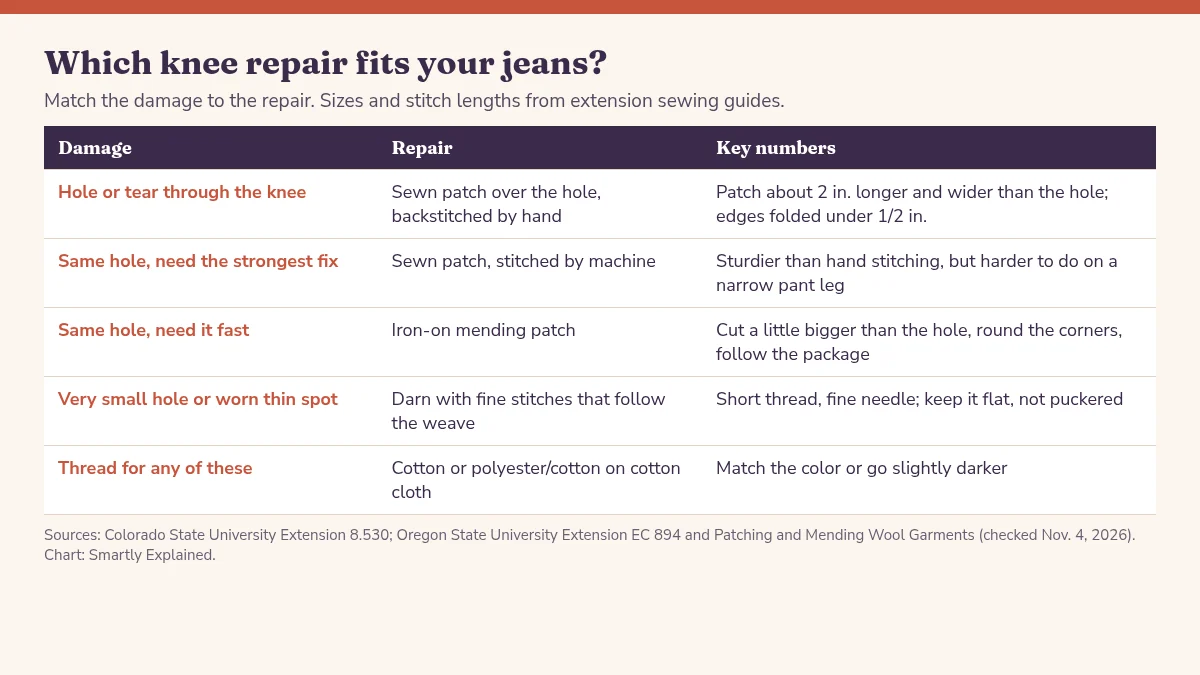
Here is how the options compare, based on the Colorado State and Oregon State guides:
- Hand-sewn patch with backstitch. The default for a hole or tear. Strong, and the stitch looks like machine stitching.
- Machine-sewn patch. Colorado State says it stays on better, but it is harder to do on small pant legs.
- Iron-on mending patch. Simple and fast, but the ironing must be done correctly to hold.
- Darn. Oregon State says darns are seldom used on any fabric except wool, or heavy fabrics with a similar texture, apart from very small holes and worn spots.
What you need
- A patch of sturdy fabric. Colorado State says to use the same kind of material as the pants if possible. Old jeans are the obvious source. Oregon State adds that on an old, faded garment, a faded patch blends in better, and that you may find matching fabric in a hem or another spot where you can spare it.
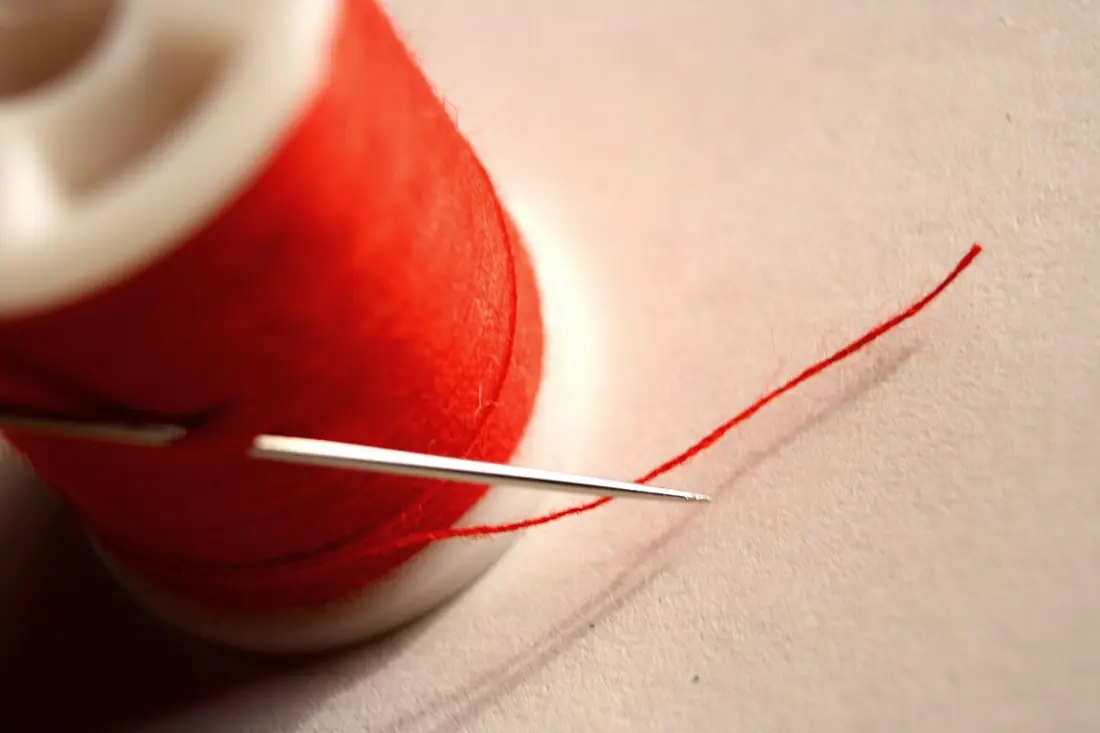
- Thread. Oregon State's basic hand-sewing stitches guide says cotton fabric calls for cotton or polyester/cotton thread. The color should match or be slightly darker than the fabric, and the wool-mending circular explains why: thread usually works up lighter than it looks on the spool. Not sure what your jeans are made of? Check the inside label. The FTC's textile labeling guide explains that federal rules require most textile products to carry a label listing fiber content.
- A needle. It should be small enough to slip through the fabric easily without leaving holes the thread doesn't fill, per Oregon State. Sharps and embroidery needles are the basics for most hand sewing.
- Pins, scissors and an iron.
- Beeswax (optional). Pulling the thread through beeswax adds strength and slipperiness, but Oregon State warns against it on fabric that is sensitive to oil stains.
Step 1: Trim the hole and cut the patch
Colorado State's method starts by cutting off the ragged edges around the hole. Then cut a piece of sturdy fabric about 2 inches longer and 2 inches wider than the hole.
Cut the patch along the grain. Oregon State's mending guide says to sew it on so the crosswise and lengthwise threads of the patch line up with the crosswise and lengthwise threads of the garment. On denim you can usually see the lines of the weave, so line the patch's lines up with the leg's.
Step 2: Fold and press the edges
Fold under all four edges of the patch 1/2 inch and press them to set the crease, per Colorado State. The folded edge is what keeps the patch from fraying, so don't skip the iron.
Step 3: Pin it flat, and keep the back of the leg clear
Pin the patch over the hole. Colorado State says to make sure it is smooth, flat and straight on the pant leg.
Slow down on this step. A pant leg is a tube, and Colorado State warns that it's easy to sew the pant leg together. Their machine-sewing tip is to bunch the leg into a "nest" and keep pulling the back of the leg away from the needle. By hand, a simple fix is to slide a magazine or a piece of cardboard inside the leg, under the patch. The needle hits it before it can catch the back layer of denim.
Step 4: Backstitch around the patch
Colorado State recommends backstitch for a strong patch by hand. Here is their method:
- Push the needle from inside the pants out through the pant leg and the patch.
- Push it back down about 1/8 inch behind where it came out.
- Bring it up again one stitch in front of that stitch.
- Keep going around all four sides.
Oregon State's stitch guide gives the same idea a range: insert the needle about 1/16 to 1/8 inch behind where it came up, and bring it out the same distance forward. For each new stitch, go in at the end of the last one. It calls backstitch a strong stitch for repairing seams and hard-to-reach areas, which is a fair description of a knee.
A few thread habits make the stitching easier. Oregon State says to cut the thread at an angle so it threads easily, and to knot the same freshly cut end you passed through the needle, which keeps the twist and the thread smooth. Its mending circular also recommends a short thread and a fine needle, because a long thread pulled back and forth tends to pull and stretch a mend out of shape. Working under a strong light helps too.
Keep the tension even. If the stitches are pulled too tight, the mend puckers. Too loose, and it looks puffy. Oregon State gives that warning for darns, and it applies just as well to a patch.
When a darn makes more sense
A darn fills a hole by weaving new thread through the fabric itself, instead of covering it. Oregon State's mending guide advises:
- using thread that blends with the fabric
- taking tiny stitches and not pulling them taut at the turns
- running the stitches unevenly into the fabric around the edge, so there is no hard line where the darn begins
- darning on the right side, where you can see whether it blends in
- pressing the finished darn from the wrong side
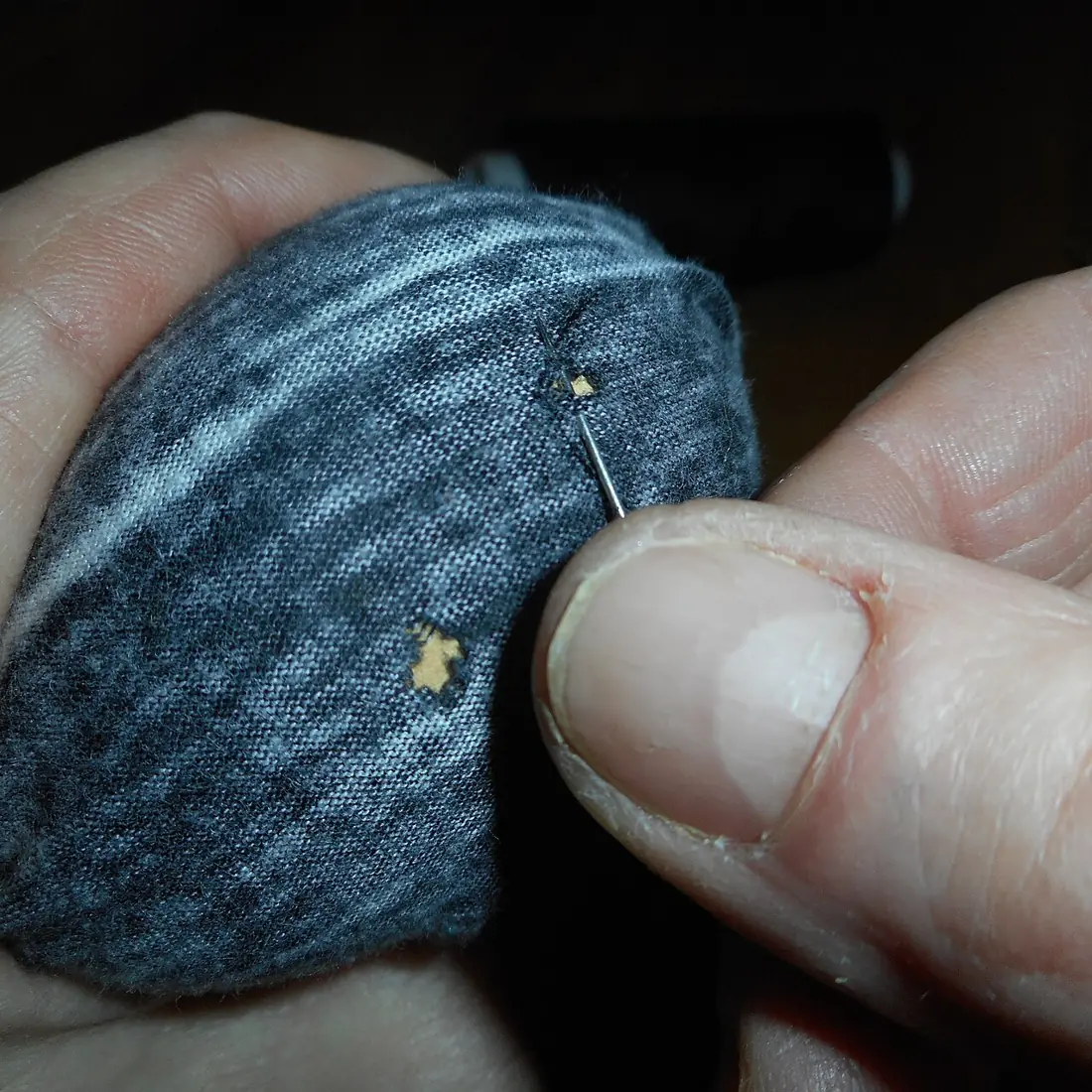
On jeans, darning is for very small holes and worn spots that haven't fully opened up yet. Catching a thin knee early with a few rows of fine stitches may save you a full patch later.
If you'd rather iron it on
Colorado State says an iron-on patch only holds if the ironing is done correctly, so follow its steps closely:
- Cut the patch a little bigger than the hole and round off the corners.
- Put a folded grocery sack or newspaper inside the leg so the patch won't stick to the back of the leg.
- Press the area around the hole first, so it is smooth and warm.
- Lay the patch shiny side down and straight.
- Hold the iron firmly on the patch. Lift it to move to the next section; don't slide it. Press all the edges.
- Let it cool, then check. If it hasn't stuck, press again.
Why bother
Mending keeps a pair in use, and every pair kept in use is one less headed for the trash. The EPA's textiles data estimates that the U.S. generated 17 million tons of textiles in 2018 and that landfills received 11.3 million tons. The EPA put the recycling rate for textiles in clothing and footwear at 13 percent.
Once the patch is on, wash the jeans as usual. If they come out smelling off after the first wash, that's a washer and drying issue, not the repair; our guide to why laundry still smells after washing covers the fixes. And if the weave talk here made you curious, the same idea comes up in our breakdown of bamboo vs. percale sheets for hot sleepers.
Questions readers ask
Can I patch jeans from the inside instead?
You can, but the extension method in this guide puts the patch on the outside, over the hole, with its edges folded under so they can't fray. Pick one approach and keep the patch flat and on the same grain as the leg.
What size should the patch be?
About 2 inches longer and 2 inches wider than the hole after you trim the ragged edges, according to Colorado State University Extension. That leaves room to fold each edge under 1/2 inch.
Is hand sewing strong enough for a knee?
Yes, if you use backstitch. Colorado State calls it the stitch for a strong patch, and it looks like machine stitching. A machine-sewn patch is sturdier, but it's harder to sew on a narrow pant leg.
Should I darn a knee hole instead?
Usually not. Oregon State's extension guide says darns are seldom used on anything but wool or similar heavy fabrics, apart from very small holes and worn spots. A patch is the better fit for a real hole in denim.
Do iron-on patches work?
They are fast, but Colorado State notes the ironing has to be done correctly for the patch to hold. Follow the package directions, put paper inside the leg, press without sliding the iron, and check the bond once it cools.
Sources and fact-check
- Patching Knees in Pants, no. 8.530, Colorado State University Cooperative Extension (1995)
- Basic Handsewing Stitches, EC 894, Oregon State University Extension Service (reprinted 1993)
- Patching and Mending Wool Garments, Oregon State University Cooperative Extension Service
- Textiles: Material-Specific Data, U.S. Environmental Protection Agency
- Threading Your Way Through the Labeling Requirements Under the Textile and Wool Acts, Federal Trade Commission
Rules change. Spot something out of date? Tell us.