How to Organize Deep Pantry Shelves So Nothing Gets Lost in the Back

The short answer
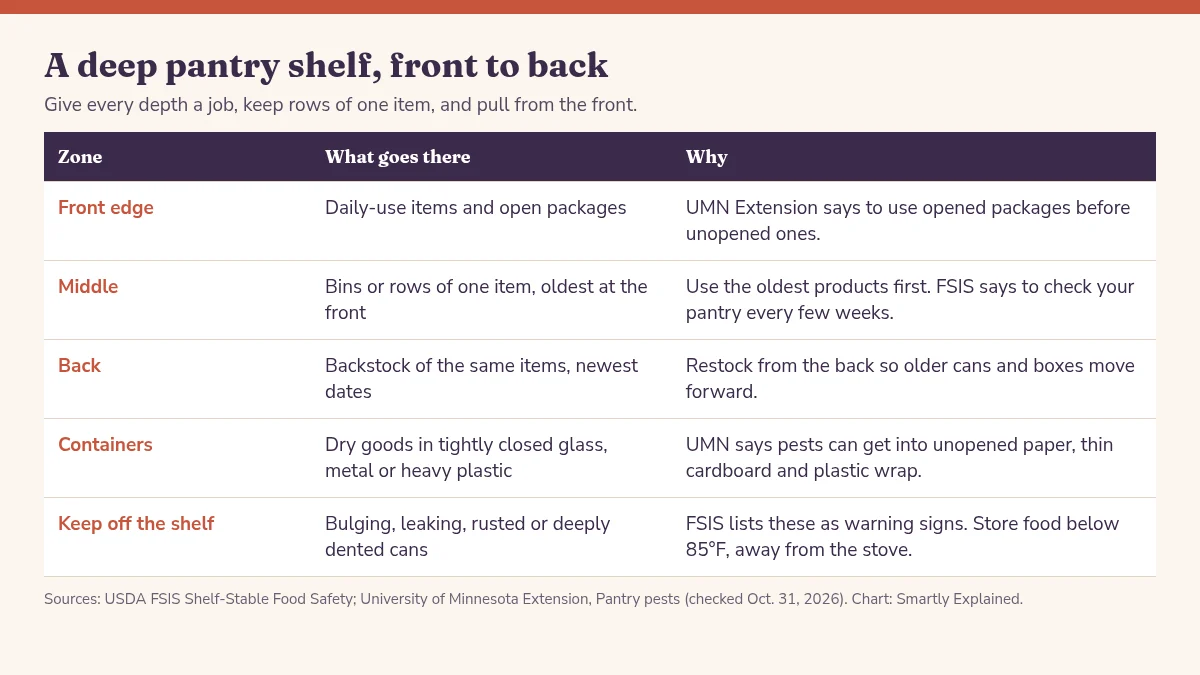
To organize deep pantry shelves, give every depth a job. Keep daily-use items and opened packages at the front edge. Line up rows or bins of one item in the middle, oldest at the front. Put backstock of those same items behind them, so restocking from the back pushes older food forward. Pull-out bins turn the hard-to-reach back into a drawer, and clear, sealed containers keep dry goods visible and pest-proof.
In this explainer
Why deep shelves go wrong
A deep shelf hides whatever sits behind the first row. You buy a second jar of something you already had, and the first one ages in the dark. The fix isn't more containers. It's a layout where nothing can hide.
Food safety agencies give the same advice. The USDA Food Safety and Inspection Service shelf-stable food guide says to check your pantry every few weeks and use canned goods you have had on hand for a while. University of Minnesota Extension says to use the oldest products before newer ones, and opened packages before unopened ones. A deep shelf makes both hard unless you plan for it.
Step by step
- Empty one shelf and measure it. Write down the depth, width and the height between shelves. Every bin you buy should fit those numbers, not the other way around.
- Sort before you store. Group like with like: baking, breakfast, pasta and grains, canned vegetables, canned fruit and tomatoes, snacks. Toss anything that's clearly spoiled or bug-infested (see below).
- Assign the zones. Front edge: what you reach for every day and anything already open. Middle: rows of one item. Back: extra stock of those same items.
- Make lanes, not piles. Line up each item in a single row from front to back, like a store shelf. When you take the front can, the next one is right behind it. When you shop, add new stock at the back.
- Use bins as drawers. For loose packets, snacks and small jars, a bin as deep as the shelf works like a drawer: pull it out, grab, slide it back. Label the front end so you don't have to look inside.
- Lift the back row. A stepped shelf riser lets you read the labels of cans behind the front row.
- Use a turntable in corners. A spinning tray brings bottles and jars from a dead corner to the front.
- Keep a short list on the door. Note what's in backstock so you don't buy it twice.
Decant dry goods into sealed containers
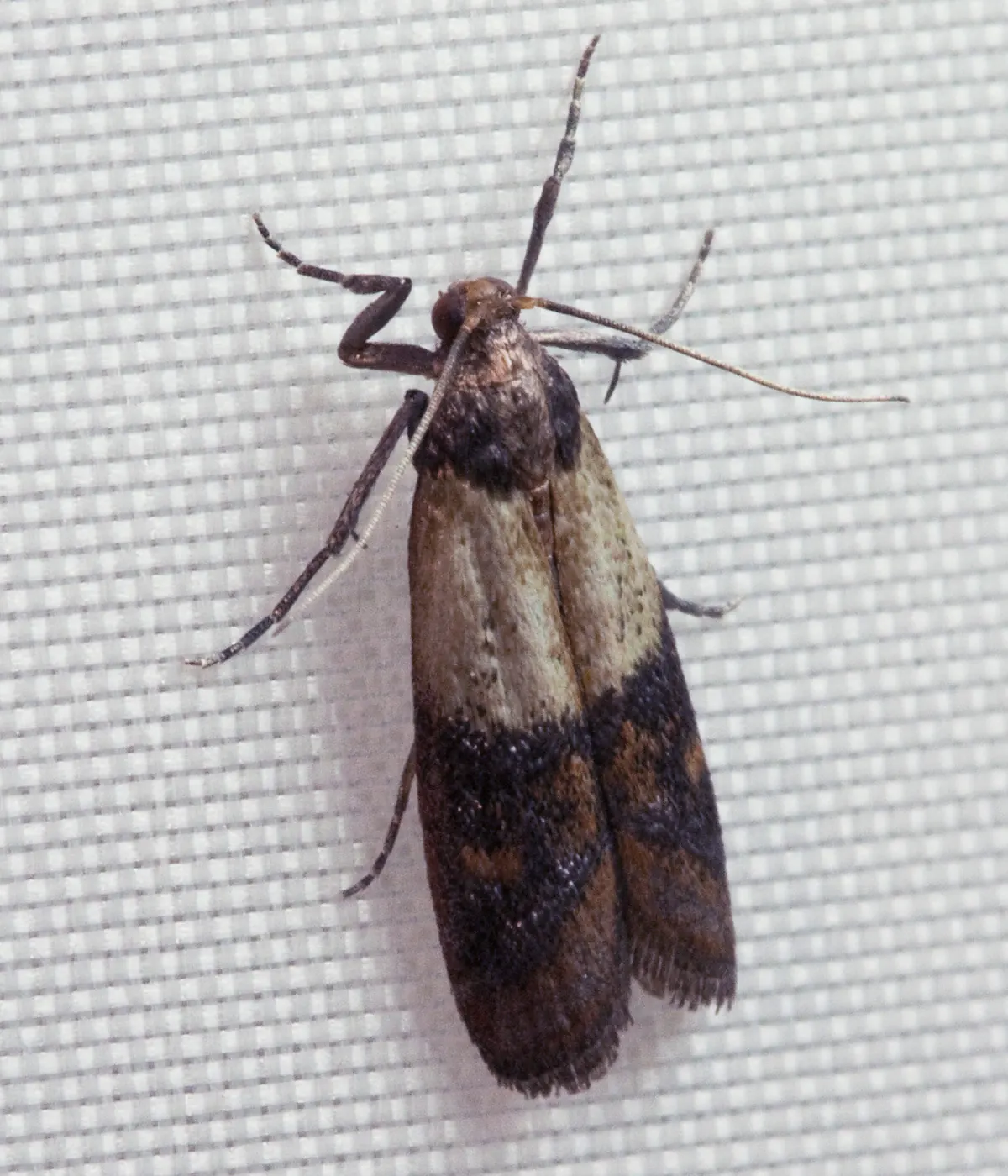
Clear containers do more than look tidy on a deep shelf. They keep insects out. UMN Extension says pantry pests are most likely to infest opened products, but they can also get into unopened paper, thin cardboard, and plastic, foil or cellophane-wrapped packages. They may chew their way in or crawl through folds and seams.
UMN's prevention list fits a deep pantry well:
- Buy dried foods in quantities small enough to use up in two to four months.
- Inspect packages before buying. They should be sealed and unbroken, with no holes.
- Store insect-free foods in tightly closed glass, metal or heavy plastic containers, or in the refrigerator or freezer.
- Clean up crumbs and spills right away, and vacuum the cracks and corners of shelves.
- Check and clean where pet food and birdseed are stored, since both can be infested.
Two common tricks don't work. UMN says there is no evidence that bay leaves or sticks of spearmint gum in a cupboard prevent or get rid of pantry pests, and washing shelves with detergent, ammonia or bleach will not prevent infestation.
If you find moths or beetles
UMN Extension says to throw infested food away, vacuum the shelves (especially cracks and corners), and then empty the vacuum or discard the bag. Look at the top surface of other products with a flashlight, or pour them onto a cookie sheet, because there could be more than one infested source. It's normal to see an Indianmeal moth flying for up to three weeks afterward. If they're still around after three weeks, there's an infested food source you haven't found.
Put the pantry in the right spot
Where the shelves are matters as much as how they're arranged. FSIS says to store canned food and other shelf-stable products in a cool, dry place, and never above or beside the stove, under the sink, in a damp garage or basement, or anywhere exposed to temperature extremes. It says temperatures below 85 degrees F are best.
Also check the label before you shelve a can. FSIS notes that not all canned goods are shelf stable. Some canned ham and seafood are not safe at room temperature and will be labeled "Keep Refrigerated."
How long food lasts at the back of the shelf
The back row is where food sits longest, so it helps to know the rough limits. These come from FSIS for unopened commercially canned food:
| Food | Examples (FSIS) | On the shelf |
|---|---|---|
| High-acid canned goods | Juices, tomatoes, fruit, pickles, sauerkraut | 12 to 18 months |
| Low-acid canned goods | Canned meat and poultry, stews, soups (except tomato), vegetables, beans | 2 to 5 years |
Dates on the label are mostly about quality. The FSIS guide to food product dating says a "Best if Used By/Before" date shows when a product will be at its best flavor or quality, and is not a purchase or safety date. Except for infant formula, it says, product dating is not required by federal regulations. The codes stamped on cans are packing codes for tracking and recalls, and FSIS says they aren't meant to be read as "use-by" dates. Writing the purchase month on the lid with a marker makes rotating a deep shelf easier.
Cans to keep off the shelf
FSIS says not to buy bulging, rusted, leaking or deeply dented cans. It also lists leaking, bulging or badly dented cans, cracked jars, and jars with loose or bulging lids among possible botulism warning signs, and says not to even taste the food. Don't tuck them at the back. FSIS says to double bag such cans in tightly closed plastic bags and put them in a trash receptacle outside the home.
If rice is one of your bulk staples, our guide on how to store bulk rice long term covers containers and shelf life in more detail.
Questions readers ask
What is the best way to organize a deep pantry?
Split each shelf into front, middle and back zones. Put daily items and opened packages at the front, rows or bins of one item in the middle with the oldest at the front, and backstock of those same items behind. Pull-out bins turn the back of the shelf into a drawer.
How often should I check my pantry?
The USDA Food Safety and Inspection Service says to check your pantry every few weeks and use canned goods you have had on hand for a while.
How long do canned goods last on a pantry shelf?
USDA FSIS lists high-acid canned foods such as tomatoes, fruit and pickles at 12 to 18 months, and low-acid canned foods such as soups, vegetables and canned meat at 2 to 5 years.
How do I keep bugs out of pantry food?
University of Minnesota Extension says to buy dried foods in amounts you will use within two to four months, inspect packages before buying, store insect-free food in tightly closed glass, metal or heavy plastic containers, and vacuum cracks and corners of shelves.
Sources and fact-check
- Shelf-Stable Food Safety, USDA Food Safety and Inspection Service
- Food Product Dating, USDA Food Safety and Inspection Service
- Pantry pests: Insects found in stored food, University of Minnesota Extension
Rules change. Spot something out of date? Tell us.