Bamboo vs Percale Sheets for Hot Sleepers: Read the Label Before You Choose

The short answer
Bamboo and percale aren't opposites on the same scale. "Bamboo" tells you where the fiber's cellulose came from, and "percale" tells you how the yarns were woven, so a store shelf that sets "bamboo sheets" against "percale sheets" is really comparing a silky bamboo rayon sateen with a crisp cotton percale. If you run hot and like a dry, cool, slightly papery feel, start with a cotton percale around 350 thread count or lower. If you want something smooth and drapey that still isn't polyester, a bamboo rayon or lyocell sheet is a fair choice. Neither one has good evidence of keeping you measurably cooler all night, so the label, the weave and the thread count matter more than the marketing.
In this explainer
Fiber and weave are two different questions
Every sheet answers two questions. The first is fiber: cotton, rayon, lyocell, polyester or a blend. The second is weave, the pattern the yarns are interlaced in.
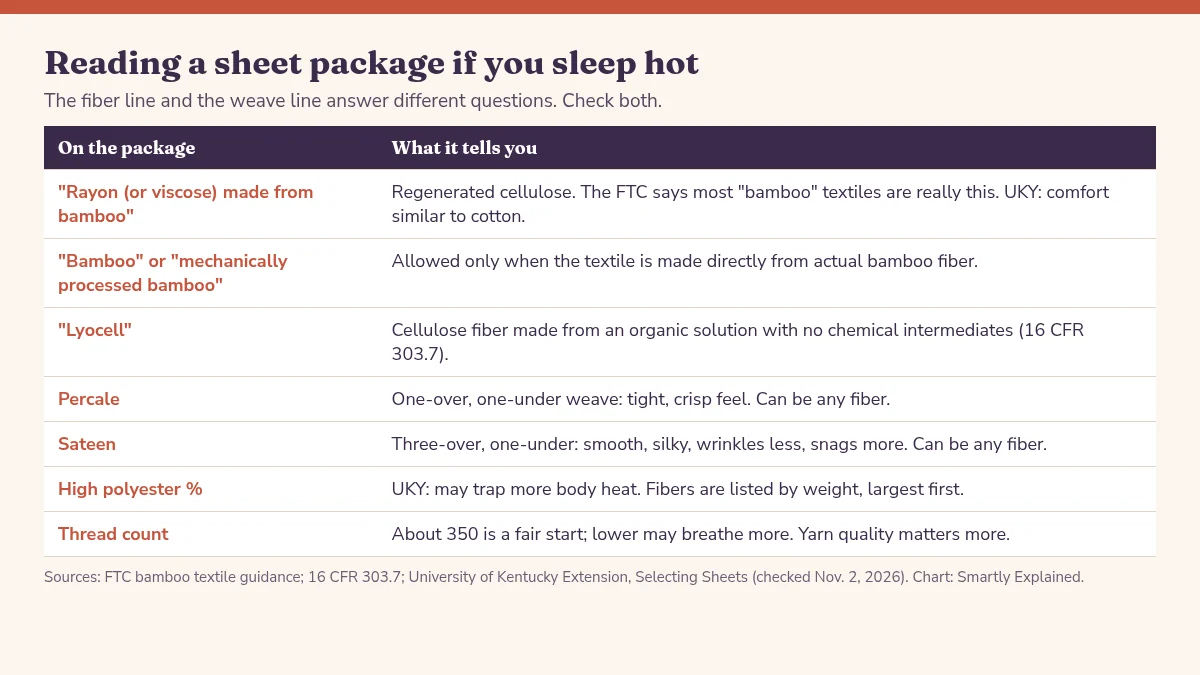
The University of Kentucky Extension bulletin on selecting sheets describes the two common weaves this way. Percale is a one-over, one-under (plain) pattern that usually gives a tight weave and a crisp feel. Sateen floats the yarns in a three-over, one-under pattern, so it feels smooth and silky and is less likely to wrinkle, but the looser structure makes it more prone to snags. The bulletin also notes that either weave can use yarns of any fiber content.
That's why "bamboo percale" exists. If a bamboo sheet feels much slicker than a cotton percale in the store, check the weave before you credit the fiber. Compare like with like when you can: a bamboo rayon percale against a cotton percale tells you far more about the fiber than a bamboo sateen against a cotton percale does.
What "bamboo" on the package usually means
The plant isn't what touches your skin. The Federal Trade Commission says that most "bamboo" textile products, if not all, are really rayon, and that "there's no trace of the original plant in the finished rayon product" (FTC guidance for sellers of bamboo textiles). Federal rules define rayon as a manufactured fiber of regenerated cellulose, and the FTC says bamboo is only one of several plants that can be used as the source material.
The labeling rule follows from that. According to the FTC's bamboo textiles page, a textile can only be called bamboo if it's made directly from actual bamboo fiber. Rayon made from bamboo, and viscose (which the FTC says is the same thing), may be labeled "rayon (or viscose) made from bamboo." The FTC calls fiber made directly from the plant "mechanically processed bamboo."
The FTC has enforced this more than once. Its bamboo page lists a January 2013 case in which four national retailers agreed to pay penalties totaling $1.26 million for allegedly labeling textiles as bamboo when they were actually rayon. In 2022 it went further: in its April 2022 announcement on Kohl's and Walmart, the agency said the proposed orders required the two retailers to pay civil penalties of $2.5 million and $3 million, a total of $5.5 million. The complaints also challenged eco-friendly claims, and the FTC said that converting bamboo into rayon "requires the use of toxic chemicals and results in hazardous pollutants."
Lyocell, viscose and modal on the tag
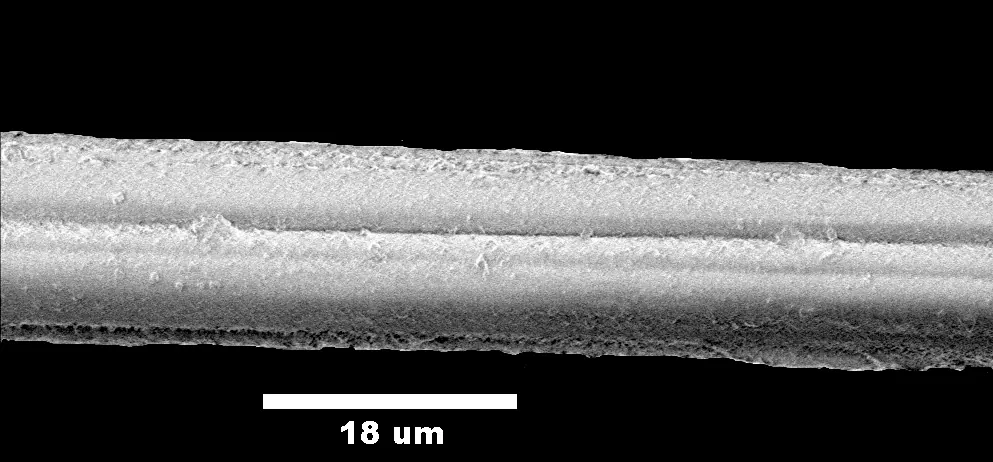
Packages use several names for regenerated cellulose, and the federal definitions in 16 CFR 303.7 explain how they relate. Rayon is defined as a manufactured fiber of regenerated cellulose. When the cellulose is precipitated from an organic solution with no substitution and no chemical intermediates, "the term lyocell may be used as a generic description of the fiber." In other words, lyocell sits inside the rayon category. "Bamboo lyocell" and "bamboo viscose" are both bamboo-sourced rayon, made by different processes.
That difference matters for environmental claims. It doesn't change the basic fact that you're buying a manufactured cellulose fiber, not a woven plant.
What makes a sheet feel hot or cool
Three things on the label do most of the work for a hot sleeper.
The weave. A plain percale weave gives the crisp, flat hand many hot sleepers like. Sateen's floating yarns give a smoother, silkier surface. Neither is wrong, but if you kick off sateen sheets at 2 a.m., try percale before you blame the fiber.
The thread count. The Kentucky bulletin suggests a thread count of about 350 as a good place to start, "keeping in mind that a lower thread count may be more breathable." It also says the yarn quality, including yarn size, has more effect on how sheets feel than the thread count does. A very high number on the box isn't a cooling feature.
The fiber mix. The same bulletin warns that sheets with a high polyester content may trap more body heat, and it says that bamboo fibers are processed into rayon and "can have comfort properties similar to cotton." That's a useful, plain reading: bamboo rayon and cotton are close enough that the weave and the polyester share often matter more than the bamboo-or-cotton choice.

What the research on cooling sheets shows
Less than the ads suggest. A 2025 pilot study in Frontiers in Sleep by Weaver and colleagues opens by noting that "research on the effectiveness of these products is limited" (cooling bed sheets pilot study, Frontiers in Sleep). The team followed 64 adults who identified as hot sleepers before and after they switched to one company's sheets. The share who reported trouble sleeping because they felt too hot dropped from 82.5% to 39.7%, and reported sleep time rose by 26 minutes.
Read those numbers with the study's limits in mind. It had no control group and no randomization, it tested a single manufacturer's product, the research was supported by that company, and the authors say their results need to be confirmed in a randomized, placebo-controlled study. Also, the sheets tested were 100% cotton treated with a cooling finish. The study says nothing about bamboo against percale.
The same paper offers one useful piece of background: the body's ability to regulate its temperature is reduced during sleep, especially during REM sleep. That's why the whole bed setup counts, not only the top layer. A breathable sheet under a heavy comforter is still under a heavy comforter.
How to read the package in the store
The FTC's textile labeling guide says the generic fiber names and the percentage by weight of each fiber must be listed in descending order of predominance (FTC guide to Textile Act labeling). Use that rule as a checklist:
- Find the fiber line, not the front of the box. "100% viscose from bamboo", "rayon made from bamboo" or "lyocell from bamboo" are the honest forms. A tag that says only "100% bamboo" on a silky sheet is worth a second look.
- Check the polyester share. Blends list polyester by percentage. If it's the first fiber listed and you sleep hot, keep looking.
- Find the weave word. Percale, sateen or "plain weave". If the package doesn't say, the feel is a fair clue: crisp usually means percale, smooth and silky usually means sateen.
- Look past the thread count. Around 350 is plenty, and lower can breathe better.
- Be wary of health claims. The FTC says sellers need evidence for claims such as rayon keeping natural antimicrobial properties from the bamboo plant.
Care for people who sweat at night
The Kentucky bulletin recommends washing sheets at least every two weeks, or more often if the sleeper tends to sweat at night, and advises against washing sheets with towels or other items of different fabric weights. It also suggests keeping one set of sheets for cooler weather and one for warmer weather, which is an easy way to try percale in summer without giving up a favorite sateen.
Sweat-soaked sheets that come out of the washer smelling sour usually point to the machine or the routine rather than the fabric. Our guide on why laundry smells after washing and how to fix the washer covers the usual causes. For any sheet, follow the care label, since it is written for that specific fabric and finish.
Questions readers ask
Is bamboo lyocell the same thing as bamboo viscose?
Not quite, but they belong to the same legal family. Under the federal fiber definitions, lyocell is a type of rayon made by dissolving cellulose in an organic solvent without chemical substitution. Viscose is another name for rayon. Both are manufactured fibers, and either one can be made with bamboo as the plant source.
Does a higher thread count make sheets hotter?
It can. University of Kentucky Extension suggests a thread count around 350 as a starting point and notes that a lower thread count may be more breathable. The same bulletin says yarn quality affects the feel more than the thread count number does.
Can a sheet be bamboo and percale at the same time?
Yes. Percale describes the weave, a one-over, one-under pattern, and extension guidance says either weave can use yarns of any fiber content. So a bamboo rayon percale sheet is possible, and it will feel crisper than a bamboo rayon sateen.
Sources and fact-check
- Bamboo Textiles, Federal Trade Commission
- How to Avoid Bamboozling Your Customers, Federal Trade Commission
- FTC Uses Penalty Offense Authority to Seek Largest-Ever Civil Penalty for Bogus Bamboo Marketing from Kohl's and Walmart (April 8, 2022), Federal Trade Commission
- 16 CFR 303.7, Generic names and definitions for manufactured fibers (eCFR)
- Threading Your Way Through the Labeling Requirements Under the Textile and Wool Acts, Federal Trade Commission
- Selecting Sheets for Restful Sleep (Health Bulletin, February 2023), University of Kentucky Cooperative Extension
- Weaver et al., A non-randomized pre-post pilot study of cooling bed sheets in hot sleeping people, Frontiers in Sleep (2025), via PMC
Rules change. Spot something out of date? Tell us.