How to Find a Quiet Hotel Near the Airport Before or After a Red-Eye

The short answer
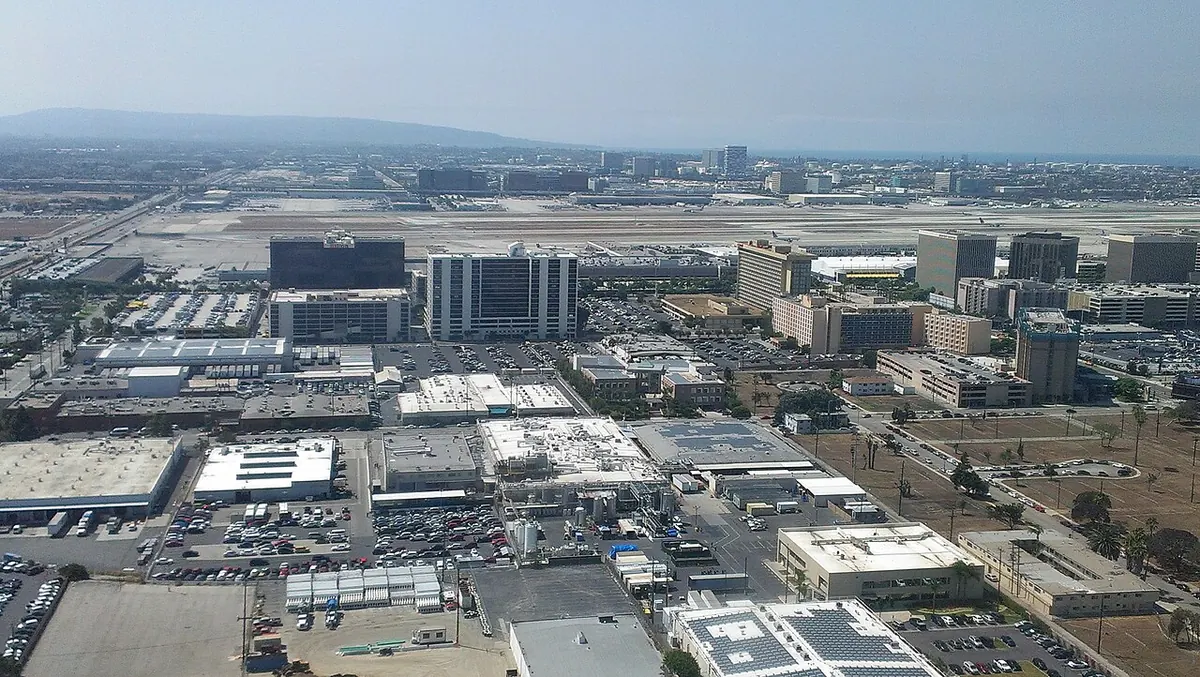
A hotel two minutes from the terminal is only useful if you can sleep in it. Before you book, decide which hours you'll actually be in bed, then check three things the airport publishes for free: its noise contour map, its flight tracker, and any curfew or night rules. Pick a hotel outside the loudest contours and away from the main approach and departure paths, ask for a room on the side of the building facing away from the runway and the highway, and bring foam earplugs you know how to fit.
In this explainer
Start with your sleep window, not the map
A red-eye puts you in an airport hotel at an odd hour. If you're flying out at 11 p.m., you want a few hours of rest in the late afternoon or evening. If you land at 6 a.m., you want to sleep through the morning. Those are different problems, because airport noise isn't spread evenly across the day.
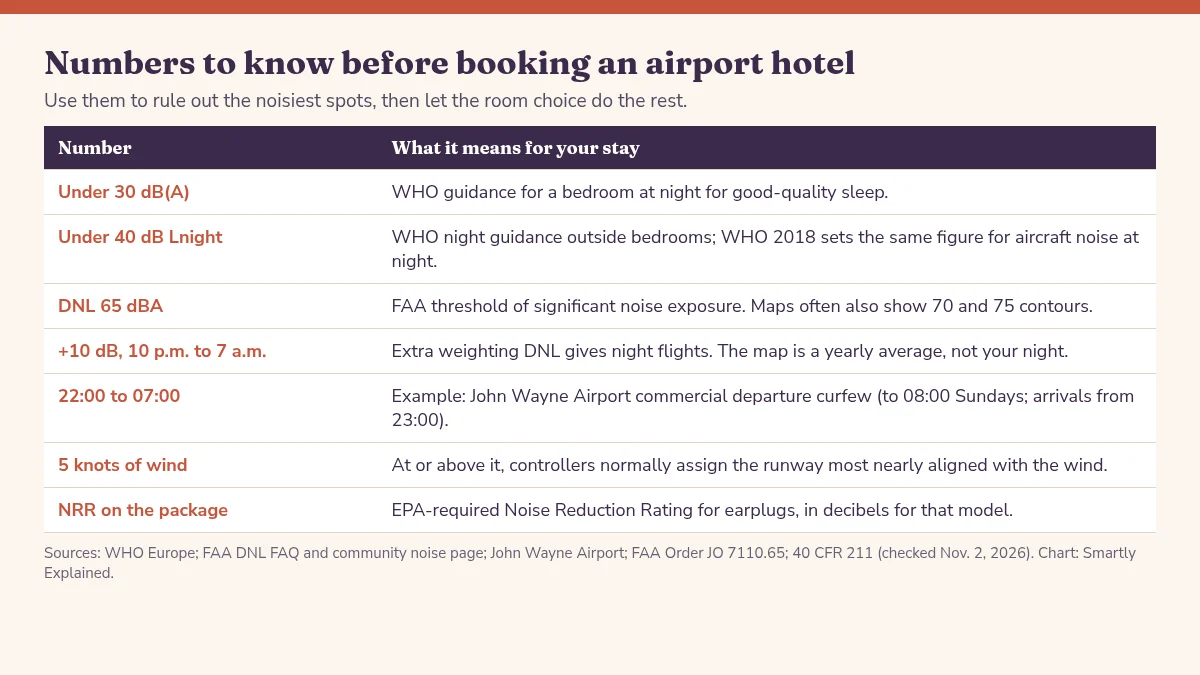
The FAA's main noise measure, the day-night average sound level (DNL), is built around this. It adds up the noise from every operation over 24 hours and applies an extra 10 dB weighting to flights between 10 p.m. and 7 a.m. (FAA). The FAA says the weighting is there to account for a higher sensitivity to noise at night. It also means a single DNL number can't tell you what the hotel sounds like at 7:30 in the morning, when you might be trying to fall asleep after a red-eye.
Write your window down before you start: "asleep 7 a.m. to noon, Tuesday" or "nap 5 p.m. to 9 p.m., Friday." Every check below is about those hours.
Check the airport's noise contour map
Start by checking whether your airport publishes a noise contour map. Contours are lines on a map connecting points with the same average noise level, a bit like elevation lines on a topographic map (FAA noise fundamentals). The FAA uses DNL 65 dBA as its threshold of significant noise exposure and often shows contours for DNL 65, 70 and 75 dBA for reference (FAA community noise). In California, the FAA accepts a closely related metric called CNEL.
How to use it for a hotel:
- Search the airport's website for "noise contours," "noise exposure map" or "CNEL map." John Wayne Airport in Orange County, for example, posts annual CNEL noise contour maps going back to 2014 on its access and noise page (John Wayne Airport).
- Find your shortlisted hotels on the map. A hotel inside the 70 or 75 contour sits in the higher-exposure zones the map shows.
- Notice the shape. The FAA says contour shape is influenced by things like whether more arriving or departing aircraft fly over an area, so the lines hint at where traffic goes.
Two cautions. Contours are averages over a year of operations, and the FAA points out that a small number of loud flights can produce the same DNL as a large number of quieter ones. A hotel just outside the 65 line can still get a few very loud overflights. Treat the map as a way to rule out the worst spots, not a promise of silence.
If your airport doesn't publish contours, the Bureau of Transportation Statistics runs a National Transportation Noise Map that shows potential exposure to aviation, highway and rail noise together (BTS). It's handy for spotting that a "quiet" airport hotel actually sits on an interstate. Read its limits, though: BTS says the map uses simplified modeling, is meant for tracking trends, and should not be used to evaluate noise levels at individual locations or specific times.
Find out where the planes actually fly
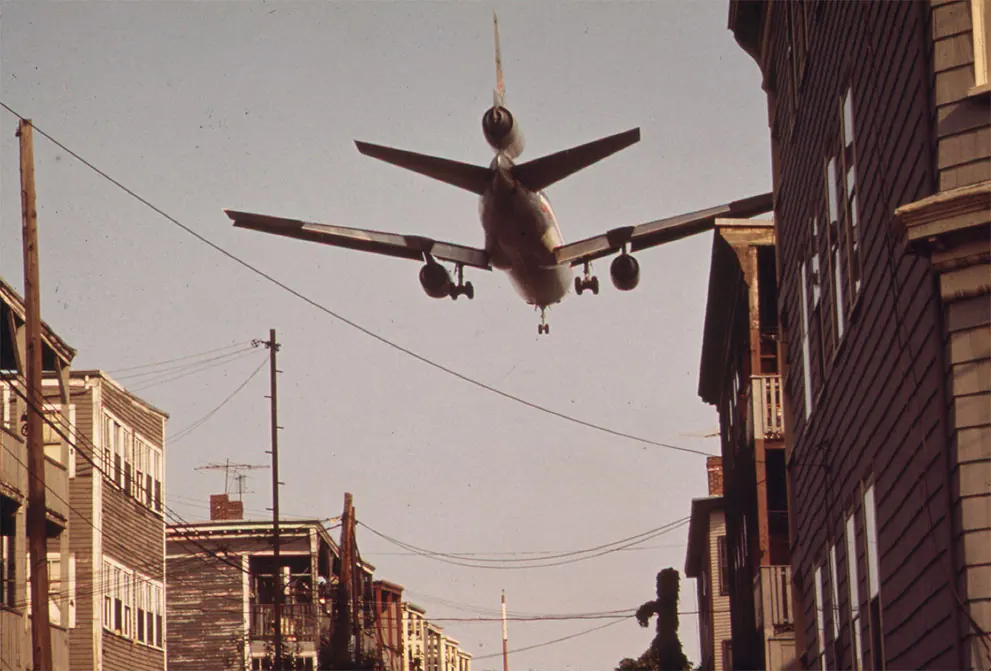
The map shows averages. A flight tracker shows what happens on a given night. Some airports link one from their noise page; John Wayne lists a Flight Tracker and noise event reports on the same page as its contours. Pull it up for the hours in your sleep window on a few recent days and watch where aircraft cross relative to your hotel.
The FAA lists the questions that decide how much noise reaches the ground: Are the aircraft taking off or landing? What is the flight path overhead? How quickly does each plane climb or descend, and at what power? Schedules matter too, varying by time of day and season, according to the same FAA community noise page.
Then there's the wind. Under the FAA's air traffic order, controllers assign the runway most nearly aligned with the wind when it's 5 knots or more, or a designated "calm wind" runway when it's lighter, unless another runway is operationally better or a runway use program is in effect (FAA Order JO 7110.65). In plain terms, the same hotel can sit under arrivals one night and hear almost nothing the next. If the tracker shows the flow switching, a hotel off to the side of the runways is a safer bet than one at either end.
Look up curfews and night rules
Some airports limit night operations, and it's worth knowing the exact hours. At John Wayne Airport, the General Aviation Noise Ordinance prohibits commercial departures between 22:00 and 07:00 (08:00 on Sundays) and commercial arrivals between 23:00 and 07:00 (08:00 on Sundays), with exceptions the airport director can approve for things like emergencies, weather and air traffic control delays. The rules and curfew reports sit on the same access and noise page as the contour maps.
Read those hours against your sleep window. A curfew is great news if you're sleeping at midnight. It does nothing for you if you land on a red-eye at 6 a.m. and climb into bed at 7, because that's when commercial departures can start again. For a morning sleeper, the first departure bank matters more than the curfew.
What "quiet" means in numbers
It helps to know what you're aiming for. WHO guidance for community noise recommends less than 30 dB(A) in bedrooms at night for good-quality sleep, and its night noise guidance recommends less than 40 dB(A) as an annual average outside bedrooms (Lnight) (WHO Europe). WHO's 2018 guidelines for Europe add an aircraft-specific recommendation: reduce night-time aircraft noise below 40 dB Lnight (WHO 2018 guidelines).
You won't get a decibel reading from a hotel, and the airport's contours use a different metric. The point of these numbers is perspective. The FAA's 65 dBA line marks significant exposure, and the WHO bedroom figure is far lower. So "outside the 65 contour" is the floor for a sleep hotel, not the goal, and the room you pick inside the building does a lot of the remaining work.
Pick the room, not just the hotel
Once you've chosen the hotel, the room choice is where you can still win. These are practical habits rather than measured rules, so ask politely and take what's available:
- Face away from the noise. Ask for a room on the side of the building facing away from the runway and any highway. The building itself acts as a barrier. BTS notes its noise map ignores shielding from barriers and terrain, and that noise may be overestimated where shielding exists, which is the same effect working in your favor here.
- Stay away from the building's own noise. Elevators, ice machines, stairwells, the lobby bar, the pool deck and the breakfast room all get busy at the hours a red-eye traveler sleeps.
- Mention your hours when you book. "I'm landing on a red-eye and sleeping from 7 a.m." tells the front desk what you need, and it's a natural moment to ask whether they sell a day-use rate or an early check-in.
- Search reviews for specific words. "Planes," "runway," "thin walls" and "highway" turn up more useful complaints than star ratings do.
- Test the room when you arrive. Close the windows and curtains, listen for a minute, and ask to move right away if it's loud. It's easier before you unpack.
Bring earplugs and fit them properly
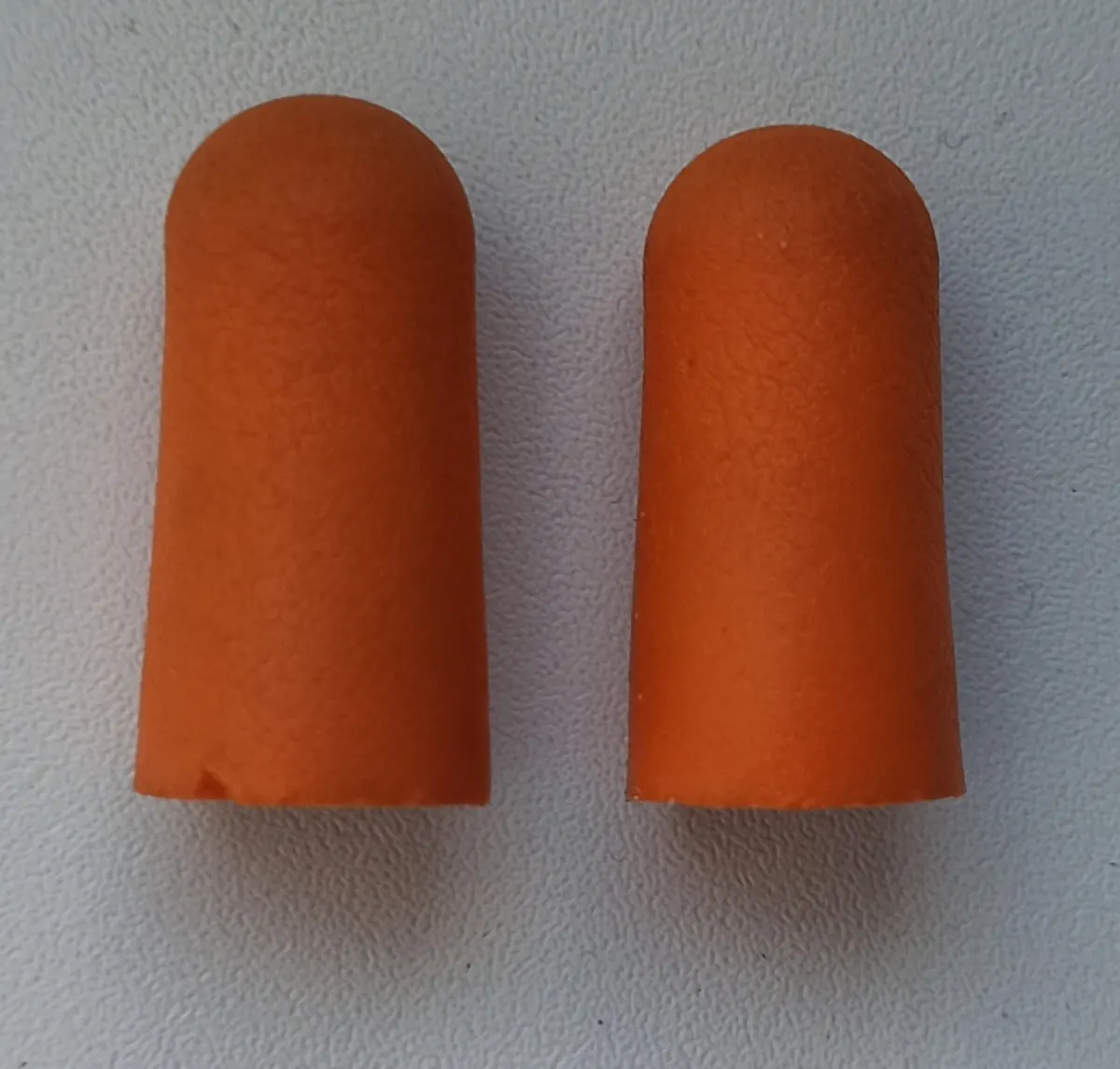
Earplugs are the cheapest insurance. In the U.S., federal EPA rules require hearing protector packages to be labeled with a Noise Reduction Rating (NRR), stated in decibels for that model (eCFR, 40 CFR 211). Look for "Noise Reduction Rating" on the package to compare products.
The rating only helps if the plug seals. NIOSH teaches a three-step method for soft foam plugs: roll the plug into a thin "snake," pull the top of your ear up and back with the opposite hand to straighten the ear canal, then hold the plug in with a finger until it expands. Your voice should sound muffled when it has sealed, and most of the foam should sit inside the ear canal. To check, cup your hands tightly over your ears; if sounds get much more muffled, the plug may not be sealing, so take it out and try again (NIOSH). Use clean hands.
If you're also trying to sleep on the plane itself, our guide on how to sleep on a red-eye flight from the gate to landing covers seats, light, noise and the morning after.
The five-minute version
Short on time at the booking screen? Do these in order:
- Write down the hours you'll be asleep.
- Open the airport's noise contour map and cross off hotels inside the 70 and 75 lines.
- Check the flight tracker for your sleep hours on two or three recent days.
- Look up any curfew and compare it to your hours, especially after a morning landing.
- Book, then ask for a room facing away from the runway and highway, far from the elevator, and pack foam earplugs.
Sources and fact-check
- What is DNL and why does the FAA use it?, Federal Aviation Administration
- Community Response to Noise, Federal Aviation Administration
- Fundamentals of Noise and Sound, Federal Aviation Administration (updated March 29, 2022)
- National Transportation Noise Map, Bureau of Transportation Statistics
- FAA Order JO 7110.65, Chapter 3 Section 5: Runway Selection
- Access and Noise: Reports and Resources, John Wayne Airport, Orange County
- Noise fact sheet, WHO Regional Office for Europe (December 1, 2011)
- Environmental Noise Guidelines for the European Region, WHO (2018)
- 40 CFR Part 211 Subpart B, Hearing Protective Devices (eCFR)
- How to Wear Soft Foam Earplugs, NIOSH (updated October 28, 2026)
Rules change. Spot something out of date? Tell us.