How to Sleep on a Red-Eye Flight: A Plan From Gate to Landing
Pick a window seat if you sleep leaning, block light and noise, skip alcohol and late caffeine, buckle your belt over your blanket, and sleep on your destination's night. A step-by-step plan, a packing list and what to do the next morning.

The short answer
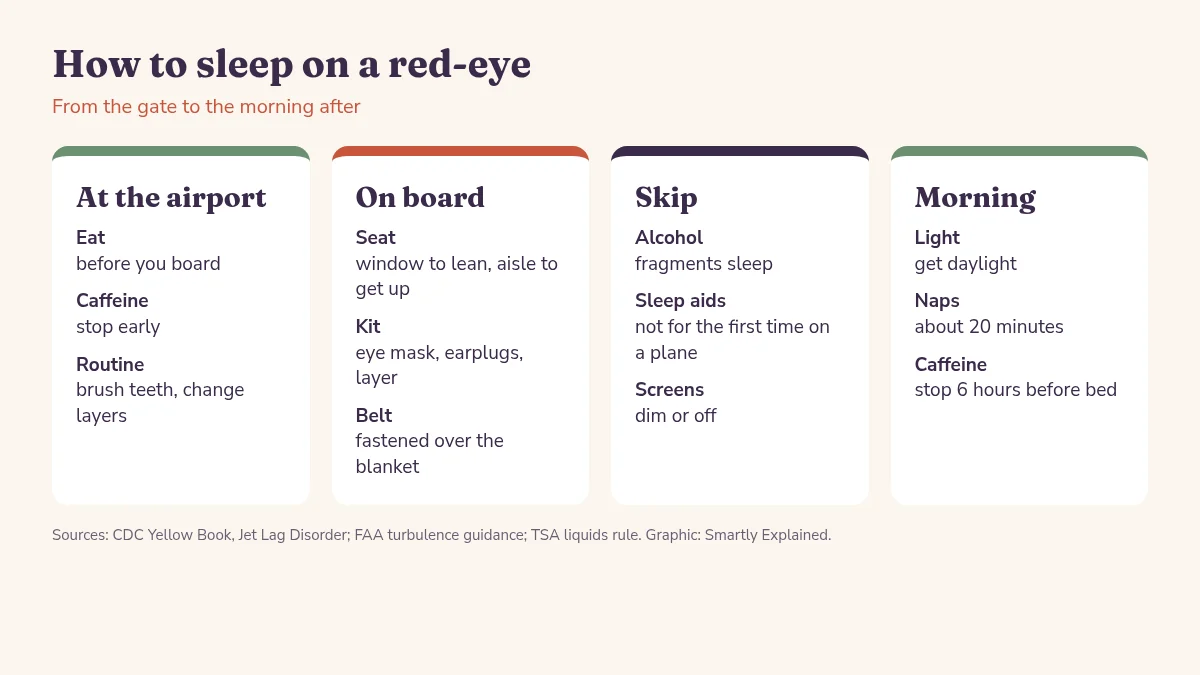
To sleep on a red-eye, set yourself up before you board: choose a window seat if you sleep leaning on something, wear layers, eat at the airport, and stop caffeine in the afternoon. Once you're in the air, block light with an eye mask and noise with earplugs or headphones, skip the alcohol, buckle your seat belt over your blanket so the crew doesn't need to wake you, and go to sleep as soon as the cabin settles. CDC's travel guidance says to time sleep and light to your destination's clock and to keep alcohol and caffeine low for better in-flight sleep (CDC Yellow Book).
In this explainer
Pick the right seat
Seat choice matters more on a red-eye than on any other flight. Use your own habits to decide:
| If you... | Choose | Why |
|---|---|---|
| Sleep leaning on something | Window | A wall to lean on, and no one climbs over you |
| Get up at night | Aisle | You won't wake your row, and walking is easy |
| Are tall | Aisle or a paid extra-legroom seat | Room to shift your legs |
| Are light-sensitive | Window (shade under your control) | You decide when it opens |
| Are traveling with a partner | Window plus middle | You only disturb each other |
Being able to move matters on long flights. CDC says anyone traveling more than 4 hours can be at risk for blood clots and recommends moving your legs often and exercising your calf muscles (CDC). If you have clot risk factors, ask your doctor before the trip; CDC notes some people may benefit from graduated compression stockings.
What to pack in your personal item
Keep everything for sleeping in the bag under the seat in front of you, not in the overhead bin:
- Eye mask and earplugs. The Walter Reed Army Institute of Research tips in the CDC chapter suggest both for sleeping during a flight.
- Noise-canceling headphones if you have them.
- A layer or travel blanket. Cabin temperature varies.
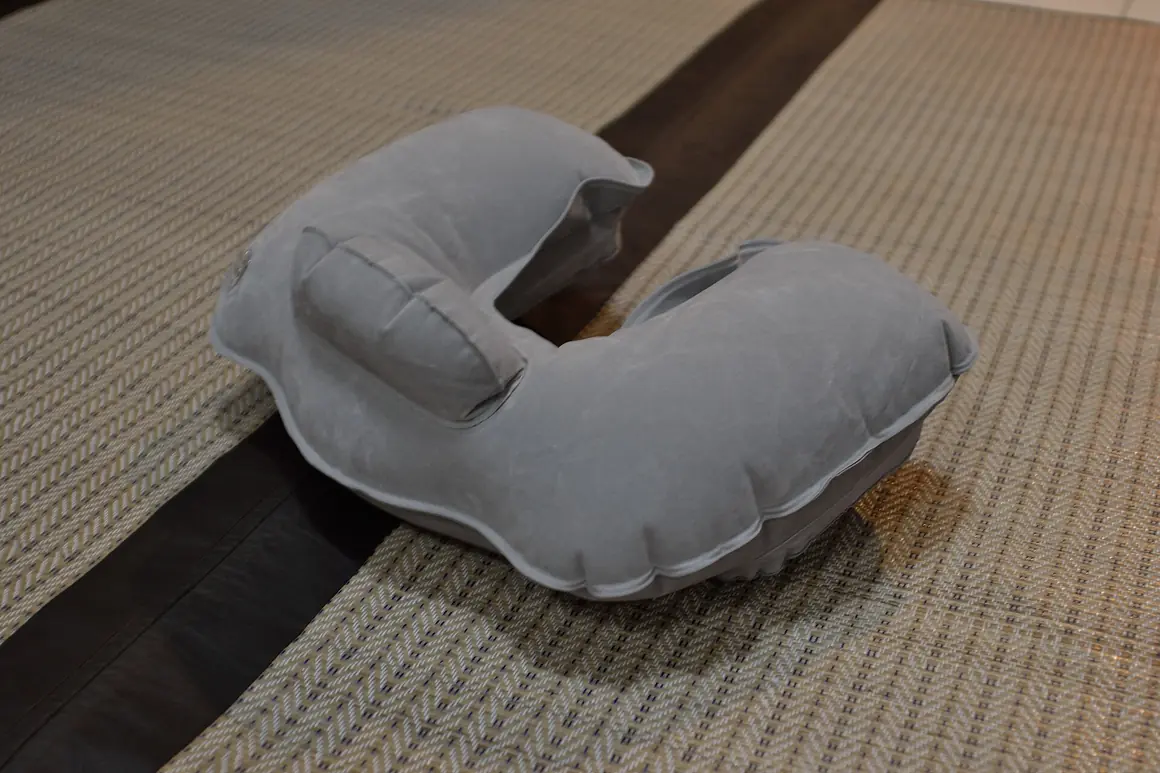
- Neck pillow if you sleep sitting up.
- An empty water bottle to fill after security. At the checkpoint, liquids must be in containers of 3.4 ounces (100 milliliters) or less in one quart-size bag (TSA).
- Toothbrush and face wipes for a quick bedtime routine and a fresher landing.
Before you board
- Don't board on a sleep debt. It's tempting to stay up late so you crash on the plane. Henry Ford Health sleep specialist Virginia Skiba, M.D., advises against flying on a sleep debt and suggests banking extra sleep in the few nights before you leave (Henry Ford Health). If you're flying east, CDC notes that shifting your bedtime about 1 hour earlier per day for 2 to 3 days before the trip may shorten the adjustment (CDC Yellow Book).
- Eat at the airport, a couple of hours before the flight. Dr. Skiba recommends this so you have time to digest before you try to sleep, and suggests something low in salt (Henry Ford Health). You also won't be waiting on in-flight food service when you'd rather be asleep.
- Stop caffeine early. CDC notes caffeine's half-life is about 5 hours and advises avoiding stimulants in the hours before bed. The Walter Reed schedule in the same chapter suggests no caffeine after 4 p.m.
- Change into comfortable layers and shoes you can loosen.
- Do your bedtime routine in the terminal restroom: brush your teeth, wash your face. It's a cue that the day is over.
After takeoff
- Keep your seat belt fastened and visible. FAA rules require passengers to keep seat belts fastened whenever the seat belt sign is lit, and the FAA recommends keeping your belt buckled at all times while seated because turbulence can come without warning (FAA). Fasten it over your blanket so a flight attendant checking belts can see it without waking you.
- Recline once you're allowed, and settle in early, before the cabin lights dim.
- Skip the drink. CDC says alcohol tends to help you fall asleep faster but makes sleep more fragmented, and both alcohol and caffeine can dehydrate you, which can make jet lag feel worse.
- Drink water, but not so much that you're up every hour.
- Turn screens down or off. If you can't sleep, an audiobook or podcast with your eyes closed is still rest.
About sleep aids
CDC's jet lag chapter advises avoiding sedative medications with long half-lives during flights, and notes that melatonin isn't regulated by the FDA, so the amount in a product may differ from the label (CDC Yellow Book). Over-the-counter options carry the same problem. Dr. Skiba notes that most are sedating antihistamines that stay in your system for at least eight hours, so on a short overnight flight you may land groggy (Henry Ford Health). Compare that with your scheduled flight time. Talk to a doctor or pharmacist before using any sleep aid, and never try one for the first time on a plane.
Which "night" to sleep on
A red-eye leaves late and lands early, but what matters is the time where you're going. CDC recommends timing sleep, meals and light to the destination time zone. On a typical U.S. West Coast to East Coast red-eye, the flight runs through the destination's early-morning hours, so sleeping right after takeoff lines up with night there. Crossing more time zones? CDC also notes that for trips shorter than about 2 days, it's often better to stay on your home schedule.
The morning you land
You'll probably be short on sleep. The Walter Reed tips in the CDC chapter suggest:
- Get daylight at your destination.
- Keep naps short, about 20 minutes, to help alertness without ruining the next night.
- Use caffeine for the day, not the evening. The tips suggest stopping caffeine 6 hours before bedtime.
- Stay up until local bedtime. CDC explains that staying awake through the local day builds up your drive to sleep, which helps you sleep that night, while long daytime naps can get in the way (CDC Yellow Book).
If you fly the other way on the return trip, our guide on jet lag after flying west covers why westward trips are easier and how to adjust.
Questions readers ask
Is it better to sleep or stay awake on a red-eye?
Sleep, if it's night at your destination. CDC advises timing sleep, meals and light exposure to the destination time zone, and notes that sleep loss during travel can make jet lag worse.
Does a drink help you sleep on a plane?
It can make you drowsy, but CDC says alcohol tends to shorten the time it takes to fall asleep while making sleep more broken. CDC recommends minimizing alcohol and caffeine to get better sleep in flight.
Window or aisle seat for a red-eye?
A window gives you something to lean on and nobody climbing over you. An aisle is better if you'll get up during the night, which also makes it easy to stretch your legs on a long flight.
Can I take a sleeping pill on a red-eye?
Ask your doctor first. CDC's jet lag chapter advises avoiding sedative medications with long half-lives during flights and stresses that timing matters. Don't try a new sleep medication for the first time on a plane.
Sources and fact-check
- Jet Lag Disorder, CDC Yellow Book 2026 (Chapter 7), including Walter Reed Army Institute of Research tips
- Blood Clots and Travel: What You Need to Know, CDC
- Turbulence: Staying Safe, Federal Aviation Administration
- Liquids, Aerosols and Gels Rule, TSA
- A Sleep Expert Shares How To Actually Sleep On A Plane, Henry Ford Health (April 2025)
Rules change. Spot something out of date? Tell us.