Why Does Deicing Delay Flights? What Happens While You Wait
Planes can't legally take off with frost, ice or snow stuck to the wings. Deicing adds a queue, a spray, and a time limit; if the protection runs out before takeoff, the plane may need to be checked or sprayed again. What's happening and your rights during a long wait.

The short answer
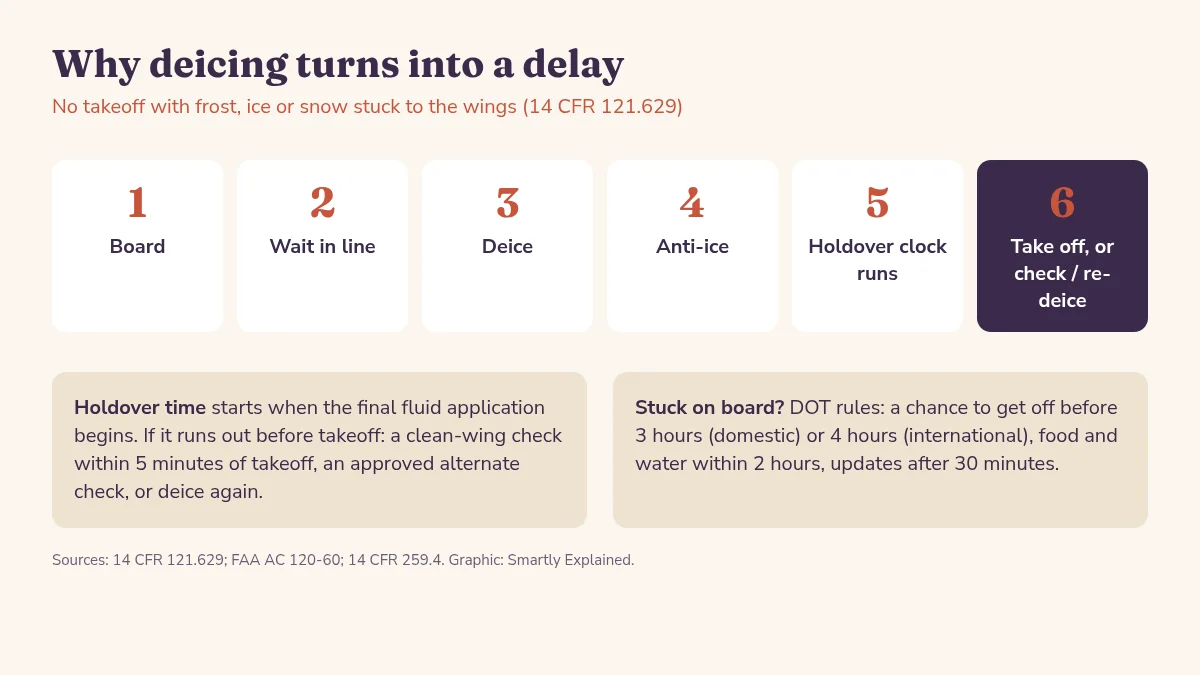
Deicing delays flights because federal rules forbid an airliner from taking off with frost, ice or snow stuck to its wings, control surfaces, engine inlets or other critical surfaces (14 CFR 121.629). Getting clean takes time: planes line up for the deicing crews, get sprayed, and then have to take off before the protective fluid stops working. If that window closes, the crew needs to confirm the wings are still clean or get sprayed again, and that is when a short delay turns into a long one.
In this explainer
What happens, step by step
| Step | What is going on | Why it can take time |
|---|---|---|
| 1. Boarding | Deicing is done as close to departure as possible, so passengers are often already on board | You may be on board for the whole delay |
| 2. Waiting in line | Planes queue for deicing trucks or a deicing pad | Everyone needs it at once during a storm |
| 3. Deicing | Fluid removes frost, ice or snow to give clean surfaces | Heavier snow means more spraying |
| 4. Anti-icing | A second fluid can protect the clean surfaces for a limited time | Required in some conditions |
| 5. Holdover time starts | The clock starts when the final fluid application begins | Taxi and runway lines eat into it |
| 6. Check or re-spray | If the time runs out, the plane must be checked or deiced again | Back into the line |
| 7. Takeoff |
Definitions from FAA Advisory Circular 120-60 and 14 CFR 121.629.
Deicing vs anti-icing
These are two different jobs. The FAA defines deicing as removing frost, ice or snow from the aircraft to give clean surfaces, and anti-icing as a precaution that protects treated surfaces against new frost, ice or snow for a limited period (FAA AC 120-60).
The same advisory circular describes two approaches:
- One-step: a single fluid both removes the ice and stays on to give limited protection.
- Two-step: deicing first, then a separate anti-icing application once the surfaces are clean, which gives the maximum possible protection.
It also explains the fluid types. Type I fluid is unthickened, forms a thin film and has very limited holdover time. Thicker fluids, such as the Type II fluid the circular describes, give longer holdover times; they form a gel-like film that flows off the wing as air moves over it during the takeoff run (FAA AC 120-60). If you have a window seat, that is the liquid you may see sliding off the wing as you speed down the runway.
The holdover clock: why you might get deiced twice
Holdover time is the estimated time the fluid will keep frost, ice and snow from building up on the protected surfaces. Under federal rules, it begins when the final application of fluid starts and ends when the fluid loses its effectiveness (14 CFR 121.629). The FAA publishes updated holdover time tables each winter season (FAA), and the times depend on the fluid, the temperature and the type and intensity of precipitation.
If a plane passes its maximum holdover time before takeoff, the rule allows it to go only if one of these happens:
- A pretakeoff contamination check confirms the wings, control surfaces and other critical surfaces are free of frost, ice and snow. FAA guidance says this check must be done within 5 minutes before takeoff begins.
- An FAA-approved alternate procedure confirms the surfaces are clean.
- The plane is deiced again and a new holdover time begins.
So a long line for the runway in heavy snow can send a plane back for another spray. That is a safety rule, not the crew being slow.
Your rights if you are stuck on the plane
DOT's tarmac delay rule applies while you wait on the ground at a U.S. airport (14 CFR 259.4):
| Rule | Domestic flight | International flight |
|---|---|---|
| Chance to get off the plane | Before the delay passes 3 hours | Before the delay passes 4 hours |
| Food and drinking water | Within 2 hours of the start of the delay | Within 2 hours |
| Working lavatories and medical help if needed | Throughout | Throughout |
| Status updates | Once the delay passes 30 minutes | Once the delay passes 30 minutes |
There are exceptions: the deplaning deadline does not apply if the pilot decides it would be unsafe, or if air traffic control says returning to the gate would significantly disrupt airport operations. Food and water can also be withheld if the pilot decides safety or security prevents service.
Tips for a deicing day
- Use the restroom and fill a water bottle at the gate. Service may pause while the plane is in line.
- Charge your phone before boarding. Waits can be long.
- Build in connection time. On snowy days, a tight connection is the first thing to break.
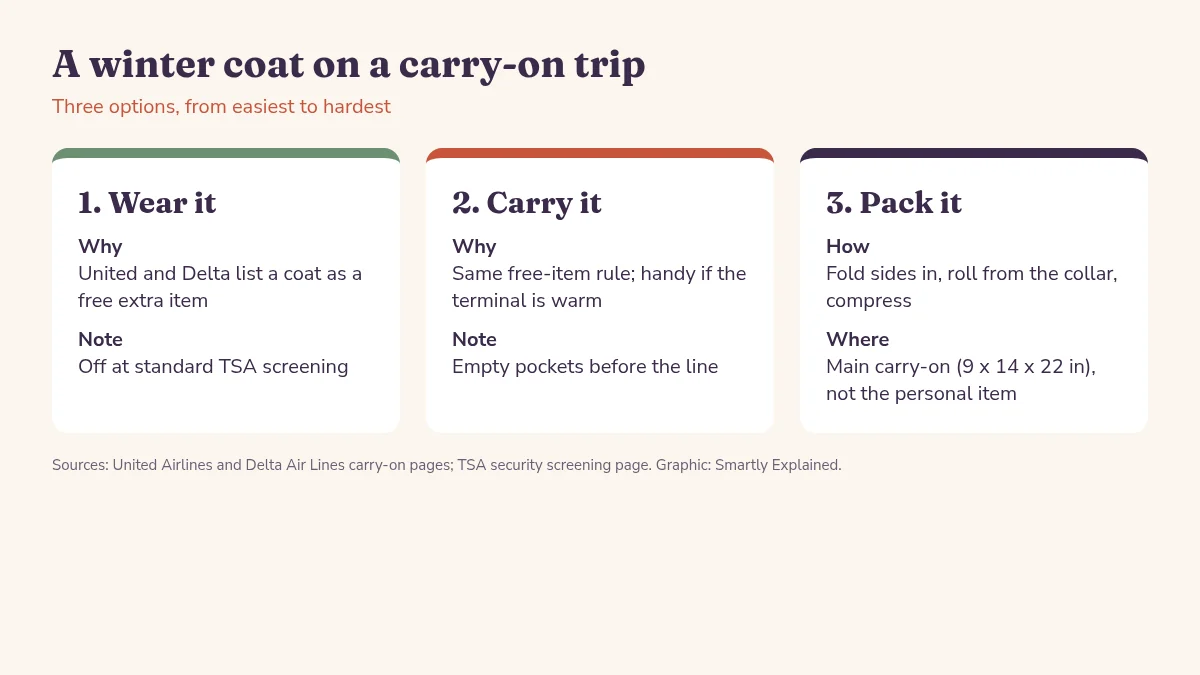
- Watch the airline app. Gate and departure times can change while you wait. If you are planning winter travel with a coat, our guide on packing a winter coat in a carry-on covers what counts against your bag allowance.
Questions readers ask
How long does deicing a plane take?
There is no fixed time. It depends on the aircraft size, how much snow or ice is on it, the weather and how many planes are in line. The biggest delays usually come from waiting in the queue and from re-spraying if protection expires.
Why did we get deiced twice?
Deicing fluid only protects the plane for a limited time, called holdover time. If it runs out before takeoff, FAA rules require a check that the wings are clean, an approved alternate procedure, or another round of deicing.
Is it safe to fly in snow after deicing?
The rules exist to make it safe: federal rules forbid taking off with frost, ice or snow adhering to the wings and other critical surfaces, and airlines must follow an FAA-approved deicing program.
Can they keep us on the plane for hours waiting to deice?
Under DOT rules, airlines must give passengers the chance to get off before a tarmac delay passes 3 hours on domestic flights or 4 hours on international flights, with safety, security and air traffic control exceptions. Food and water are due within 2 hours.
Sources and fact-check
- 14 CFR 121.629, Operation in icing conditions, eCFR
- Advisory Circular 120-60, Ground Deicing and Anti-Icing Program, FAA
- Aircraft Ground Deicing (holdover time tables), FAA
- 14 CFR 259.4, Contingency Plan for Lengthy Tarmac Delays, eCFR
Rules change. Spot something out of date? Tell us.