Airline Lost Your Bag? What to Do, Including on an Overnight Layover

The short answer
If your bag doesn't show up, go to the airline's baggage service office before you leave the airport, file a report and get a file reference number. On flights covered by U.S. rules, the airline then has to look for the bag, reimburse reasonable expenses you have while it's delayed, refund your checked-bag fee if it is significantly delayed (12 hours for domestic trips) or lost, and pay for a lost bag up to the liability limit, which is at least $4,700 per passenger on domestic flights (DOT; 14 CFR 254.4). On an overnight layover, a checked-through bag usually stays in the airline's system, so plan to spend the night with what's in your carry-on.
In this explainer
What to do at the airport, in order
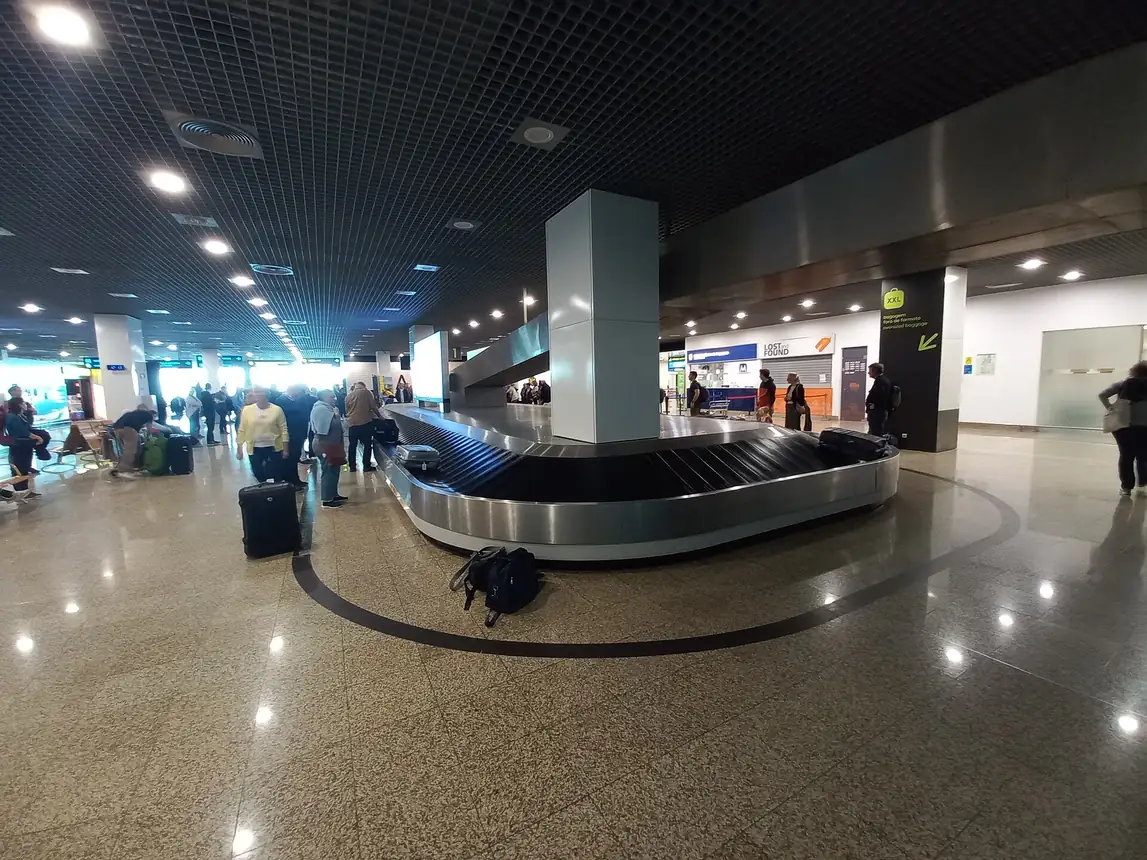
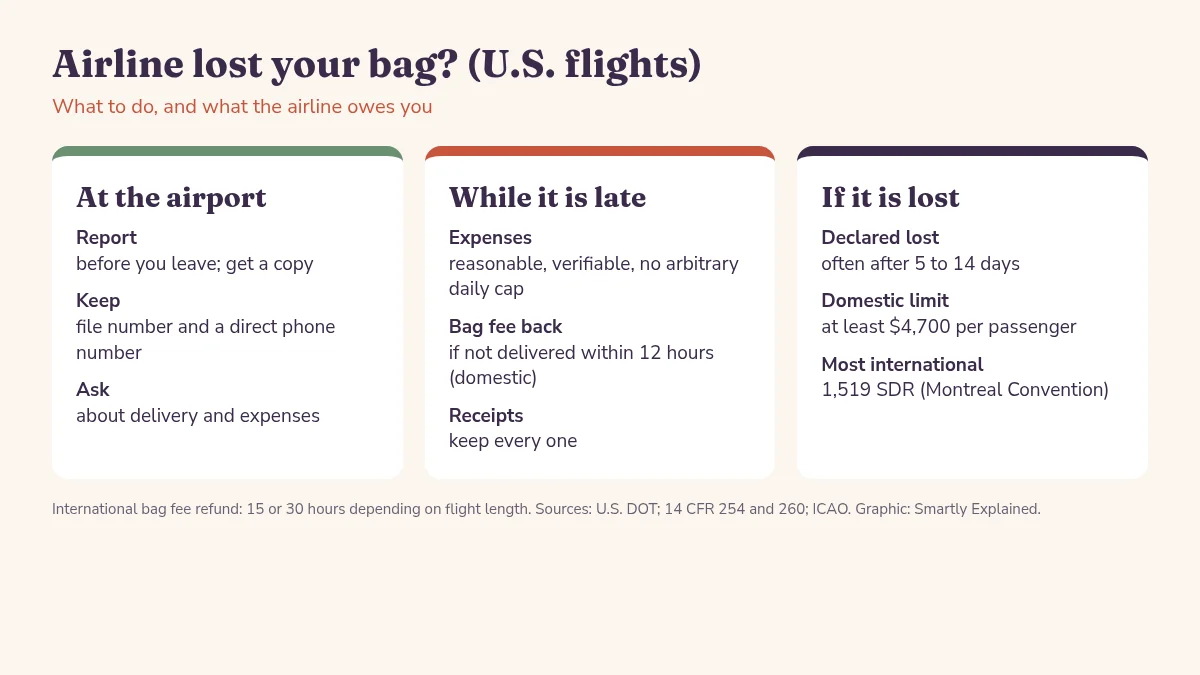
- Report it before you leave. DOT's advice is to report problems to the airline before leaving the airport and to insist the airline fill out a form and give you a copy, even if staff say the bag will be on the next flight (DOT Plane Talk). Some airlines let you file in their app.
- Get the agent's name and a phone number for following up (not reservations), per DOT, and keep the file reference number from your report.
- Give a delivery address for the night and for later in your trip. DOT suggests asking whether the airline will deliver the bag free when it's found.
- Ask about expenses. DOT suggests asking about an advance or reimbursement for things you need to buy.
- Keep your bag tag receipt and boarding pass. If the agent takes your claim checks, DOT says to make sure that is noted on your copy of the report.
Airlines set their own reporting deadlines. United, for example, says travelers in the U.S. must report a bag problem within 24 hours of arrival. Check your airline's page.
Your rights on U.S. flights
| Situation | What the airline owes you | Rule |
|---|---|---|
| Bag delayed | Reasonable, verifiable, actual incidental expenses, up to the liability limit; no arbitrary daily cap | DOT baggage guidance |
| Bag significantly delayed | Refund of the checked-bag fee, if you filed a report | 14 CFR 260.5 |
| Bag declared lost | Value of the bag and contents (depreciated), up to the limit, plus a refund of the bag fee | DOT; 14 CFR 260.5 |
| Liability limit, domestic | At least $4,700 per passenger | 14 CFR 254.4 |
| Liability limit, most international trips | 1,519 Special Drawing Rights per passenger under the Montreal Convention (since Dec. 28, 2024) | ICAO |
"Significantly delayed" has a fixed definition in federal rules: a bag not delivered within 12 hours of your last flight's arrival for domestic itineraries, 15 hours for international itineraries whose U.S.-to-foreign nonstop flight is 12 hours or less, and 30 hours when that flight is longer than 12 hours (14 CFR 260.2). The clock starts when you're given the chance to get off the plane at your final destination and stops when the bag is delivered to the place you agreed on or you pick it up.
The refund must be prompt: within 7 business days for credit card purchases and 20 calendar days for other payment types, and in the original form of payment unless you agree to something else (14 CFR Part 260).
If you're on an overnight layover
An overnight layover adds a few wrinkles:
- Your bag is usually checked to your final destination. Ask at check-in, and look at the destination code on your bag tag receipt. If it shows your final city, the bag will travel on without you needing to collect it, and you generally won't be able to get it for the night.
- Pack an overnight kit in your carry-on. DOT advises against packing small valuables and other items you can't do without in checked bags. For a planned overnight connection, add a change of clothes and toiletries.
- International trip into the U.S.? You normally collect your bags at the first U.S. airport, clear customs and recheck them. DOT says an airline doesn't owe a bag-fee refund for a delay caused by a passenger who didn't pick up and recheck bags at that first U.S. entry point.
- Separate tickets? If your flights aren't on one reservation, the first airline may only check your bag to the layover city. Pick it up there and check it again for the next flight.
- Bag missing when you finally arrive? File the report at your final destination with the airline that operated your last flight. Under the bag-fee refund rule, the report goes to the carrier that operated the last segment of a multi-airline trip.
While you wait
- Track the bag in the airline's app or with the file number.
- Buy only what you need, and keep itemized receipts. DOT says reimbursement covers reasonable, verifiable and actual expenses.
- Write down every call: date, time and the name of the person you spoke with.
When the bag is declared lost
DOT says most airlines declare a bag lost 5 to 14 days after the flight. At that point:
- File the lost-bag claim the airline asks for, listing the contents and their value. DOT notes airlines may require receipts or other proof for valuable items, and compensation is subject to depreciation and the liability limit.
- Expect the bag fee back. Airlines must refund fees you paid to transport a bag that was lost.
- Check other coverage. Some credit cards and travel insurance policies cover delayed or lost bags. Read the terms before you file.
If you can't get anywhere with the airline, you can file a complaint with the U.S. Department of Transportation through its aviation consumer protection pages.
Prevent the next one

- Put your name and contact details inside the bag as well as on the tag.
- Take a photo of your bag and its contents before you check it.
- Leave longer connections in winter; our explainer on why deicing delays flights covers why snowy days break tight connections.
Questions readers ask
How long before an airline declares a bag lost?
It varies. The U.S. Department of Transportation says most airlines declare a bag lost between 5 and 14 days after the flight, and that an airline that unreasonably refuses to do so after a bag has been missing too long could face DOT enforcement.
Will the airline pay for things I buy while my bag is delayed?
Yes, within limits. DOT says airlines must reimburse reasonable, verifiable and actual incidental expenses while a bag is delayed, and can't set an arbitrary daily cap such as $50 a day. Keep every receipt.
Do I get my bag fee back if my bag is late?
On U.S. flights, yes, if it is significantly delayed and you filed a report: 12 hours for domestic trips, 15 hours for international trips with flights of 12 hours or less, and 30 hours for longer international flights. A lost bag's fee must be refunded too.
Can I get my checked bag during an overnight layover?
Usually not if it is checked through to your final destination. Pack what you need for the night in your carry-on. Ask the airline if your connection is cancelled, since practices vary.
Sources and fact-check
- Lost, Delayed, or Damaged Baggage, U.S. Department of Transportation
- Refunds (checked bag fees), U.S. Department of Transportation
- Plane Talk: Tips on Avoiding Baggage Problems, U.S. Department of Transportation
- 14 CFR Part 260, Refunds for Airline Fare and Ancillary Service Fees (eCFR)
- 14 CFR 254.4, Carrier liability (domestic baggage), eCFR
- Track your bags (issues with checked bags), United Airlines
- International air travel liability limits set to increase (Montreal Convention), ICAO, Oct. 18, 2024
Rules change. Spot something out of date? Tell us.