How to Annotate a Book for Fun Without Overthinking It

The short answer
Grab a pencil, decide on four or five marks that mean something to you, and write the way you would talk to a friend about the book: "no way," "she's lying," "this is the third time the river shows up." That is the whole method. Everything else, the color-coded tabs and the highlighter sets, is optional decoration.
In this explainer
Annotating for fun is different from annotating for a class. Nobody grades it, so the only test is whether you enjoy flipping back through your notes later. Below is a simple system built on the best-known essay ever written about marking books, plus what preservation librarians want you to know about sticky notes.
Why bother: the book becomes a conversation
In 1941 the philosopher Mortimer Adler published "How to Mark a Book" in the Saturday Review of Literature. His argument still holds up. Buying a book is "only the prelude to possession," he wrote, and full ownership comes when you make it part of yourself, best done by writing in it. He gave three reasons: marking keeps you awake, it turns reading into thinking, and writing helps you remember both your thoughts and the author's.
His favorite image was a conversation. When you reopen a marked book a year later, your agreements, doubts and questions are waiting, "like resuming an interrupted conversation." That is the payoff for fun reading too: a reread with your past self in the margins.
Interestingly, Adler didn't think every book needed that treatment. He said light fiction read for pleasure can be read relaxed "and nothing is lost." So give yourself permission to annotate lightly, or only the books that grab you.
Make a five-mark key
A key keeps your marks readable later. Adler listed the marks he used, and they translate easily to pleasure reading:
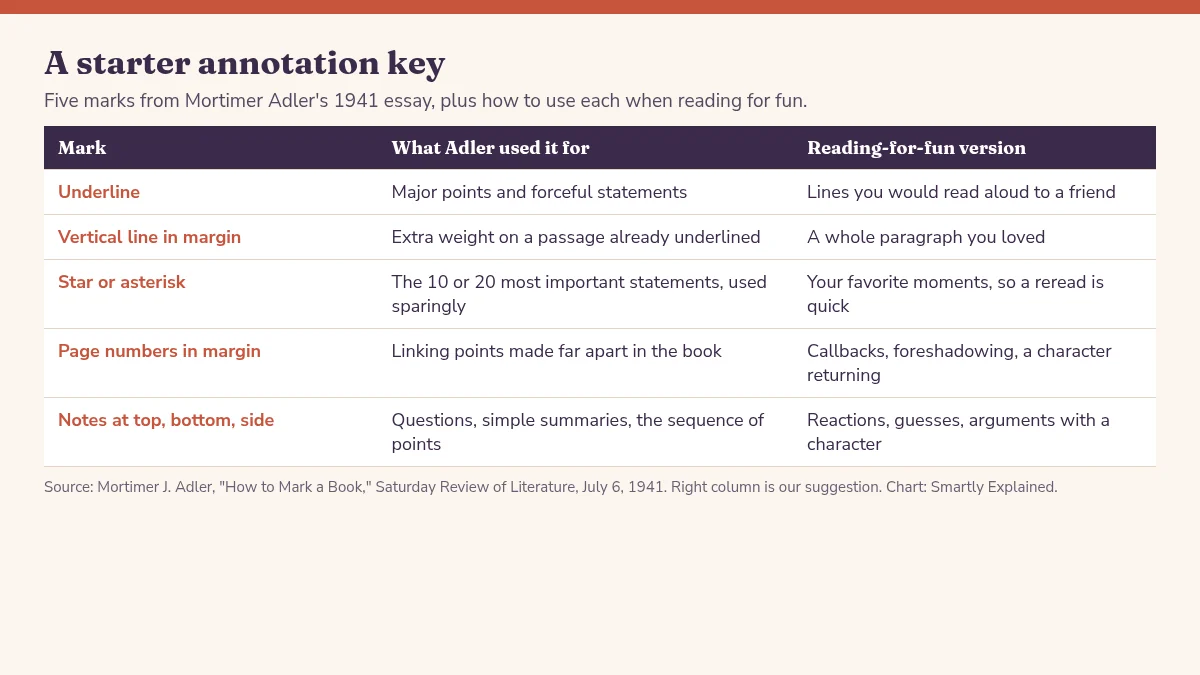
Two of Adler's habits are worth stealing. He used the blank pages at the back for a personal index of points in the order they appeared, and the front blank pages for an outline of the whole book once he'd finished. For a novel, the back pages work well as a character list with page numbers, and the front for a few lines on what you thought when you closed it.
If you would rather not write in the book at all, Adler had an answer for that too: a scratch pad slightly smaller than the page, with the sheets tucked inside the covers afterward.
Go easy on the highlighter
Highlighting feels productive, but the evidence is unflattering. A review of 10 common study techniques by John Dunlosky and colleagues in Psychological Science in the Public Interest rated highlighting and underlining as low utility for learning, alongside rereading and summarization.
Harvard Library's guide to reading habits goes further and tells students to throw away the highlighter. Its reason fits fun reading as well: bright yellow lines can look "strangely cryptic" later unless you remember why they mattered. The guide recommends a pen or pencil and words in the margin instead.
The fix is simple. Whenever you highlight, add two or three words beside it saying why. "Funny." "Callback to ch. 2." "Same lie again." Those words are what you'll actually enjoy rereading.
What to write in the margins
Here are prompts that work when you are reading for pleasure rather than for a test:
- Your gut reaction. Laughing, wincing, rolling your eyes. One word is enough.
- Predictions. Write your guess about how it ends, then come back and mark whether you were right.
- Patterns. Repeated images, words or objects. Harvard's guide suggests watching for recurring images and repeated words, and those are often what a book club ends up discussing.
- Links across the book. Note the page number where something first happened. Adler did this to tie together ideas "separated by many pages."
- Questions for someone else. If you are in a book club, mark the passages you want to bring up so they're easy to find at the meeting.
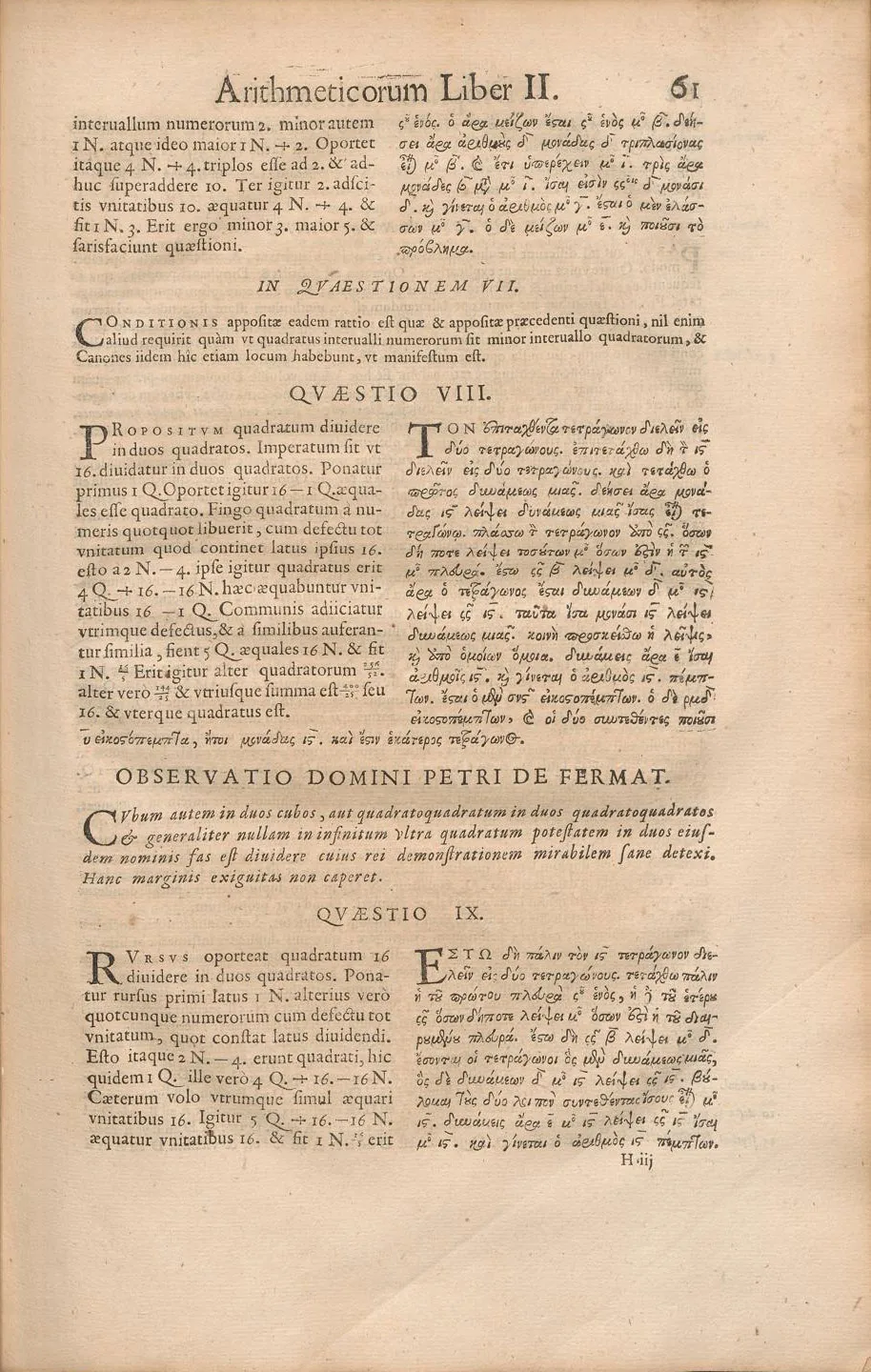
Margins have a long history of holding big ideas. Around 1630, the mathematician Pierre de Fermat wrote in the margin of his copy of Diophantus's Arithmetica that he had a truly remarkable proof that the margin was too small to contain, according to the MacTutor History of Mathematics archive. His son Samuel later collected his notes, including that one, for publication. Your notes don't need to start a famous puzzle. They just need to make sense to you.
Sticky notes and tabs: use them, then pull them out
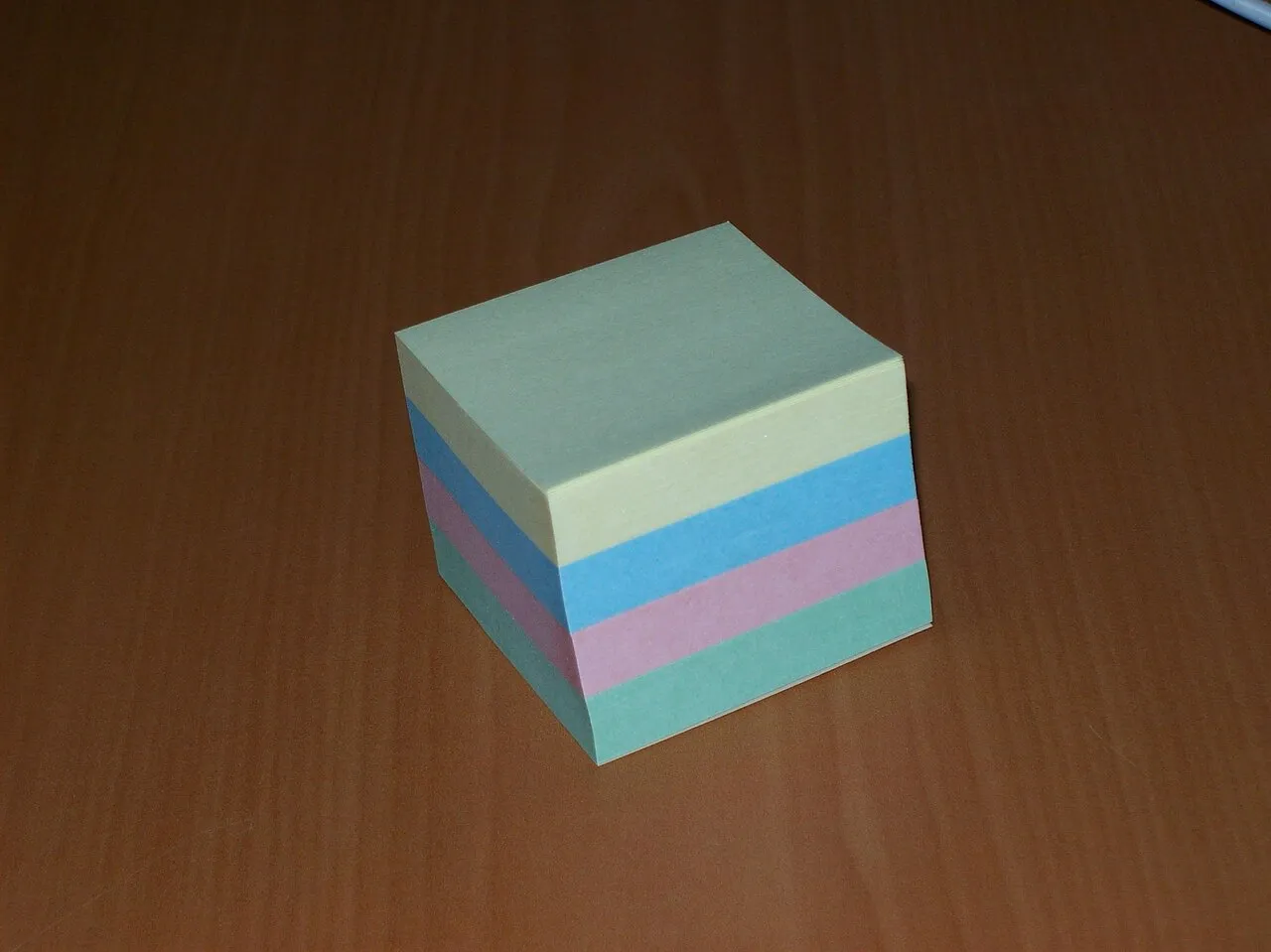
Tabs are popular for marking favorite pages, and for your own paperbacks they're fine. Just know their limits. Duke University Libraries' preservation team writes in "A Sticky Situation" that sticky notes can bleed onto the text block, leave a sticky residue and tear brittle paper when they're pulled off. Indiana University's Craig Preservation Lab adds that they get harder to remove cleanly the longer they stay, and that problems are worse in older books with weak paper.
Three habits avoid most of the damage:
- Stick tabs on the page edge, not over the text.
- In borrowed and library books, take every note out as soon as you finish.
- Remove them by peeling back on themselves at a low angle, the method Indiana's conservators use, instead of pulling straight up.
A few more ways to keep it fun
- Annotate a cheap copy. Adler suggested buying an inexpensive edition if a fine binding makes you nervous. Keep the special copy clean.
- Don't flatten the spine to write. The Library of Congress advises against forcing a book to lie completely flat, because it strains the spine. Its book handling guide suggests propping the covers so the book opens at a gentler angle.
- Pair it with a pace that suits you. Margin notes take time. If you're planning a reading week, our guide to how long a 300-page book takes can help you budget a little extra.
- Mix formats on purpose. Some readers listen to a book first and then annotate the print copy on a reread. Our look at audiobook vs reading retention explains why print helps with the parts that need slow thinking.
The best annotation system is the one you'll keep using. Start with a pencil and five marks, write why something matters, and let the rest grow book by book.
Questions readers ask
Pen, pencil or highlighter?
Start with a pencil. It is quiet on the page, you can erase it, and Harvard Library's reading guide recommends pen or pencil over a highlighter because bright highlights often look cryptic later. Switch to pens once you know your system and want color.
Can I annotate a library book?
No marks in the book itself. Keep notes on a separate sheet or index cards tucked inside, and if you use sticky notes, take them out before you return it. Preservation staff at Duke and Indiana University libraries say sticky notes can stain pages, leave residue and tear brittle paper.
Will annotating slow me down?
Yes, a little, and Mortimer Adler thought that was the point. In his 1941 essay he argued there is no single right reading speed. For a light novel you are reading to relax, mark only what you love and keep moving.
How do I remove a sticky note without tearing the page?
Peel it back on itself at the lowest angle you can, rather than pulling straight up. That is the technique Indiana University's preservation lab recommends. If a layer of paper starts lifting with the note, stop.
Sources and fact-check
- How to Mark a Book, Mortimer J. Adler, Saturday Review of Literature, July 6, 1941
- Interrogating Texts: 6 Reading Habits to Develop in Your First Year at Harvard, Harvard Library
- Improving Students' Learning With Effective Learning Techniques, Dunlosky et al., Psychological Science in the Public Interest
- A Sticky Situation, Duke University Libraries Preservation
- A Post about Post-it Notes, Indiana University Libraries Craig Preservation Lab
- Fermat's last theorem, MacTutor History of Mathematics, University of St Andrews
Rules change. Spot something out of date? Tell us.