Audiobook vs Reading Retention: What the Studies Actually Measured


The short answer
I spent most of one summer driving back roads with a memoir playing through the car speakers, and when a friend asked me about it later, I could retell whole chapters. A thick history book I listened to the same summer? Almost nothing stuck. That split is roughly what the research finds. For following a narrative, your ears do about as well as your eyes. For harder material, reading has a real, measurable edge, mostly because you control the pace.
In this explainer
Here are the studies people quote, what each one actually tested, and how to use them when you choose between the paperback and the app.
The study that found no difference
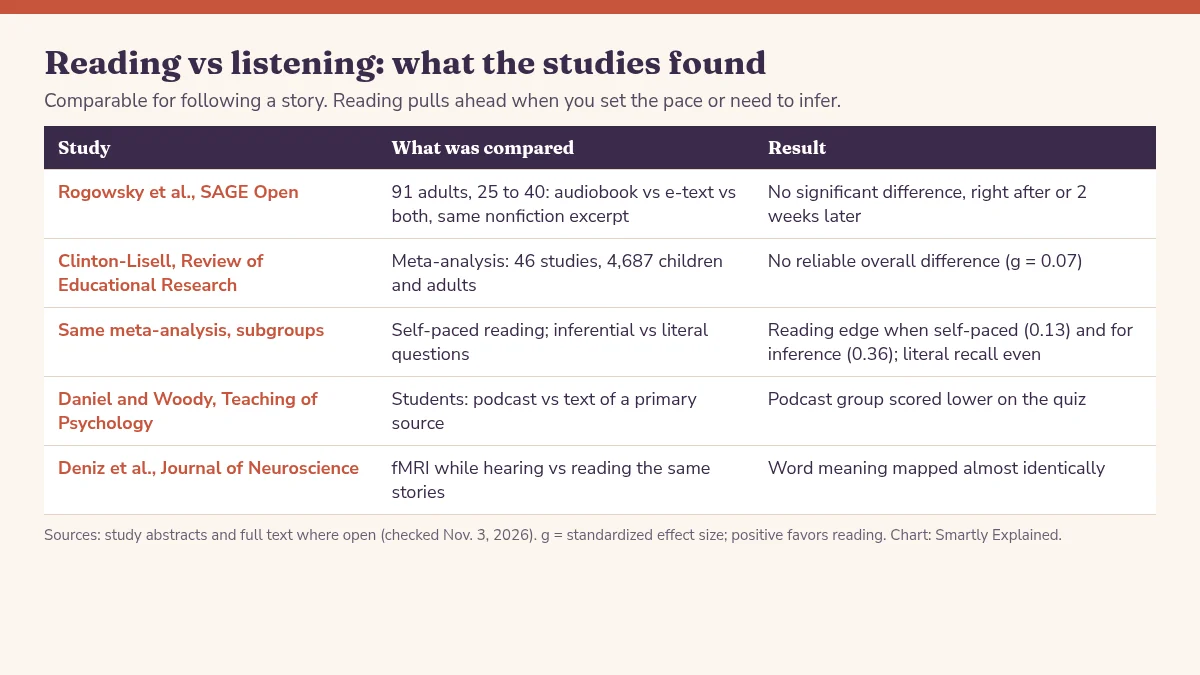
The most cited experiment is a 2016 paper in SAGE Open by Beth Rogowsky, Barbara Calhoun and Paula Tallal, "Does Modality Matter?" They randomly assigned 91 adults to one of three groups. Each group got the same material, the preface and a chapter of a nonfiction book, as a digital audiobook, as e-text on a tablet, or as both at once. Everyone then took the same written comprehension test right away and again two weeks later.
There were no statistically significant differences between the groups at either point. Men and women in every condition recalled about the same amount, whether they listened, read or did both.
Keep in mind who was tested. Participants were 25 to 40, held a bachelor's degree, were native English speakers and had normal hearing and vision. The authors say the results apply to people with well-developed listening and reading skills, and may not carry over to children, other age groups, or to fiction, textbooks and professional manuals.
The bigger picture: 46 studies at once
One study is one study. The stronger evidence is a meta-analysis by Virginia Clinton-Lisell in the Review of Educational Research, which pooled 46 studies with 4,687 children and adults.
Overall, reading and listening comprehension were not reliably different (effect size g = 0.07). The interesting part is in the subgroups:
- When readers set their own pace, reading came out ahead (g = 0.13). When the experimenter controlled the pace of reading, there was no reading advantage.
- Questions that required inference favored reading (g = 0.36), and general comprehension did too (g = 0.15). Literal questions, the kind that ask what the text plainly said, showed essentially no difference (g = −0.01).
In plain terms: if you need to remember what happened, listening is fine. If you need to connect ideas, draw conclusions or follow an argument, the page helps, especially when you can slow down and reread.
The study that found a gap
Not every result is a tie. In a classroom study published in Teaching of Psychology, David Daniel and William Douglas Woody compared students who listened to a podcast of a primary source with students who read it as text. The podcast group scored lower on the quiz. Students preferred the podcast at first, but their preference changed right after the quiz.
Rogowsky's team pointed to one key difference. In the podcast study, students could review the material before the quiz, while their own participants could not. Reviewing a recording is harder than flipping back through text, so listeners were probably less likely to re-examine it, which gave readers an advantage. That fits the pacing finding above.

Your brain handles the meaning the same way
If you have ever wondered whether listening is "real" reading at the brain level, a 2019 fMRI study in the Journal of Neuroscience by Fatma Deniz and colleagues is the one to know. Participants listened to and read hours of the same narrative stories. Semantic tuning, how brain regions respond to word meanings, was highly correlated between the two, and a model trained on one format accurately predicted responses in the other. The authors concluded that the representation of meaning is largely independent of whether it came in through the ears or the eyes.
That explains why story comprehension holds up when you listen. It does not erase the practical advantages of print: rereading, pausing, and seeing how an unfamiliar word is spelled.
The real retention killer is multitasking
Most of us listen while doing something else. Cornell University's Evidence Based Living blog points out that audiobook listening usually happens while driving, exercising or cooking, and that divided attention reduces how much we retain. The lab studies above tested people who were focused on the material. Your commute is not a lab.
So when you compare your audiobook memory to your paperback memory, ask what else you were doing at the time.
Listen or read? A practical guide
| If the book is... | Our pick | Why |
|---|---|---|
| A memoir, novel or narrative nonfiction | Listen freely | Story comprehension and recall held up in the studies |
| Dense argument, theory or history with lots of names | Read, or listen and reread key chapters | Inference and self-paced reading favored print |
| For a class, exam or work | Read | The podcast study found lower quiz scores |
| A reread of something you know | Listen | Familiar material needs less backtracking (our view) |
| Hard to fit in otherwise | Listen | A book heard beats a book not started (our view) |
Rows marked "our view" are editorial judgment, not study findings.
A few habits that help when you do listen:
- Rewind without guilt. The reading advantage came from controlling pace. Give yourself the same control.
- Save the hard chapters for quiet time. Listen to the story parts in the car and the argument parts on the couch.
- Pair formats for books you care about. If you own both the ebook and the Audible version, you can switch between Kindle and narration and reread passages you want to keep.
- Talk about it. Retelling a book is the best test of what stuck, and a book club with friends gives you a reason to.
If time is your main limit, our guide to how long a 300-page book takes to read will help you compare the hours on the page with the length of the audio edition.
The bottom line
For most adults and most leisure books, listening and reading leave you with about the same understanding. Reading earns its edge when the material is complex, when you need to make inferences, and when you take advantage of setting your own pace. Choose the format to fit the book and the moment, and give the hard parts your full attention either way.
Questions readers ask
Does listening to an audiobook count as reading?
For understanding a story or a straightforward nonfiction book, the research says it works about as well. A 91-person study found no significant difference in comprehension or two-week retention between audiobook, e-text and both together. Whether it builds reading skills the same way is a separate question that the studies here did not settle.
Is it better to read and listen at the same time?
Not measurably, for skilled adult readers. In Rogowsky and colleagues' study, the group that read along with the audio did no better than the groups that only read or only listened. It may still help if it keeps you focused, but expect similar recall, not double.
Do audiobooks at 1.5x or 2x speed hurt retention?
None of the studies covered here tested playback speed, so we cannot give you a number. What the evidence does show is that control over pace matters: reading had its edge when readers set their own pace. Slow down or rewind on the parts you want to keep.
Why do I forget audiobooks faster?
Often it is the setting, not the format. Most listening happens while driving, exercising or cooking, and Cornell's Evidence Based Living blog notes that divided attention reduces how much people retain. A podcast study also found students preferred listening at first, then scored lower than readers on the quiz.
Sources and fact-check
- Does Modality Matter? The Effects of Reading, Listening, and Dual Modality on Comprehension, Rogowsky, Calhoun and Tallal, SAGE Open
- Listening Ears or Reading Eyes: A Meta-Analysis of Reading and Listening Comprehension Comparisons, Clinton-Lisell, Review of Educational Research
- They Hear, but Do Not Listen: Retention for Podcasted Material in a Classroom Context, Daniel and Woody, Teaching of Psychology
- The Representation of Semantic Information Across Human Cerebral Cortex During Listening Versus Reading Is Invariant to Stimulus Modality, Deniz et al., Journal of Neuroscience
- Is Listening to an Audiobook as Good as Reading?, Evidence Based Living, Cornell University
Rules change. Spot something out of date? Tell us.