How to Prepare Kids for a Military Move: A Timeline From Orders to the First Month


The short answer
Most military kids attend six to nine different schools between kindergarten and 12th grade, according to the Military Interstate Children's Compact Commission. That is the reason preparing a child for a PCS is two jobs at once. One is emotional: telling them early, giving them some control and helping them rebuild friendships. The other is paperwork: getting the school liaison involved the week orders arrive and carrying the right records so the new school can place your child correctly on day one.
In this explainer
- Why the move hits kids harder than it looks
- When orders arrive: tell them, then call the school liaison
- The months before: give them a job
- The last few weeks: goodbyes and a records bag
- What the Interstate Compact makes the new school do
- If your child has special needs
- Moving week and the first 30 days
- When to get extra help
- Questions readers ask
- Sources and fact-check
This guide puts both jobs on one timeline. The school rules come from the Compact itself, so you will know what a receiving school is required to do, and what it is not.
Why the move hits kids harder than it looks
Moves cluster in summer. The Defense Centers for Public Health notes that PCS moves can happen any time of year but generally peak from May through August, and that a PCS usually comes every two to three years. For a child, that means a new school, new friends and new activities on a regular cycle, often all at once.
The Child Mind Institute's guide to moving with kids points to a less obvious problem: children don't get a say in where they're going or what they leave behind. Much of the advice below is about handing a little of that control back.
When orders arrive: tell them, then call the school liaison
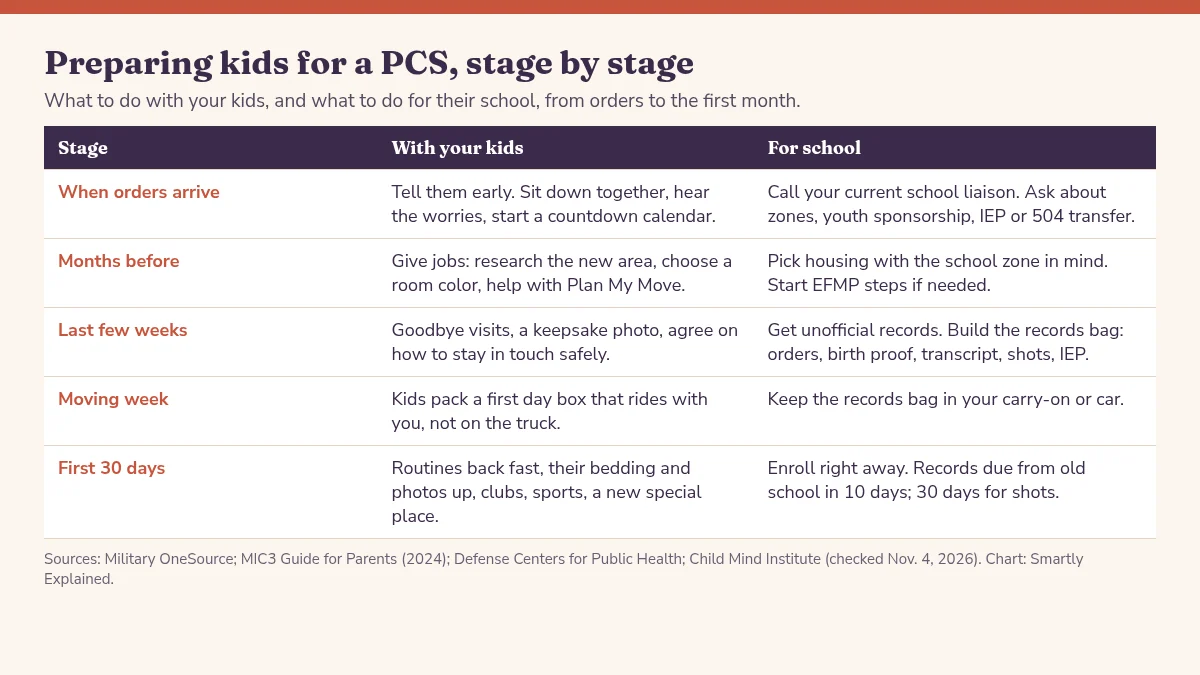
Tell your kids as soon as you can. The Army's Defense Centers for Public Health, in its article on preparing children for PCS season, recommends an open sit-down talk where everyone can say what excites and worries them, and a calendar as a visual countdown to moving day. Military OneSource gives the same advice: tell children as soon as possible and give them time to adjust and to say goodbye.
How you tell them depends on age:
- Preschoolers need short, concrete answers and lots of repeats. Military OneSource suggests reminding kids that the address changes but how much you love each other doesn't. Sesame Workshop's military families resources include The Big Moving Adventure, an app where young children create a Muppet friend and help it through a move.
- School-age kids usually want facts. Find the new home on a map together and zoom in to see what's nearby, one of Military OneSource's suggestions.
- Teens often care most about friends, sports and whether credits transfer. Give them real jobs, such as researching schools, activities and housing, which Military OneSource suggests delegating to teens.
Call your current installation's school liaison the same week. Military OneSource's page on making the move easier for military-connected children says to contact the school liaison as soon as you receive PCS orders. School liaisons help with eligibility, enrollment, placement and graduation, and your current liaison can connect you with the liaison at the new installation. Ask about:
- Which schools serve the housing areas you are considering. Liaisons know the attendance zones, so this belongs before you sign a lease.
- Youth sponsorship, which pairs your child with a peer sponsor before the move who can answer questions about the new installation and schools.
- Special education transitions, if your child has an IEP or 504 plan (more on that below).
The months before: give them a job
Kids handle change better when they are part of it. Child Mind Institute clinicians note that younger kids benefit from helping pack or choosing the color of their new room, which helps them feel in control. The Army article lists roles such as packing boxes, hosting a yard sale and sorting items to donate.
Plan My Move, Military OneSource's checklist tool, lets you build a customized list that covers child care and school records, and Military OneSource suggests letting kids contribute to it.
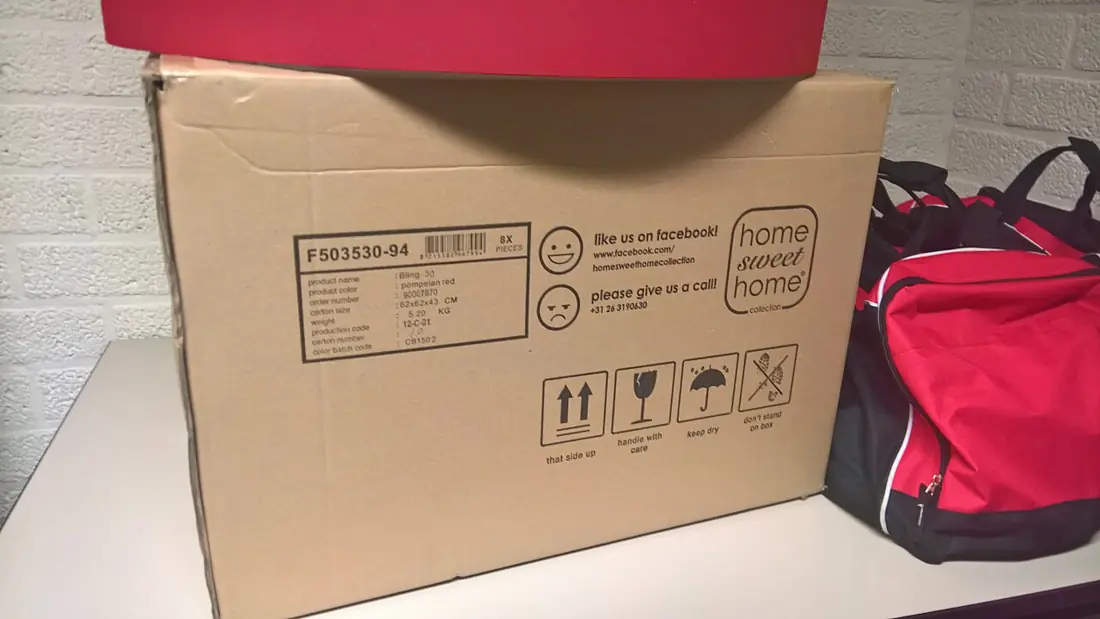
Military OneSource suggests that older kids and teens help pack household goods, while younger children pack their own belongings, favorite items or a "first day box." Keep that box with you, not on the truck. Our PCS first-night box checklist covers the adult version, and the kids' box can sit right next to it.
The last few weeks: goodbyes and a records bag
Plan the goodbyes. Military OneSource suggests visiting family favorites before you leave, such as the library, an ice cream shop or the park, and taking a photo or small keepsake from a favorite place to the new house. The Army article adds a scrapbook with pictures of friends.
Talk about staying in touch. The Army article suggests discussing safe and unsafe ways to keep in touch with friends, depending on the child's age. Settle on which apps and accounts your child can use before the goodbyes, not after.
Build the records bag. This is the step most families skip. Request unofficial copies of school records from the current school and keep them in your carry-on, along with everything else MIC3's guide says a receiving school should expect a military family to provide:
- Official military orders.
- Evidence of your child's date of birth.
- An official letter or a transcript, official or unofficial, showing attendance, academic information and grade placement.
- Documented evidence of immunizations.
- If your child lived with a guardian during the last enrollment, the family care plan or proof of guardianship.
If your child has an IEP, add a copy of it and the most recent evaluation. If the move includes a flight, our guide to documents a child needs to fly covers what to have at the airport.
What the Interstate Compact makes the new school do
The commission that governs the Compact includes representatives from all 50 states and the District of Columbia. MIC3 notes there may be slight variations between the model Compact language and the version adopted into your state's statute, so ask the school liaison or your state's Compact commissioner if something doesn't match. The MIC3 parent guide spells out the core rules:
- Enrollment can't wait for official records. The school shall enroll and appropriately place your child pending validation of official records. The receiving school requests official records, and the sending school is to furnish them within 10 days.
- Shots get a grace period. Your child has 30 calendar days from the date of enrollment to meet immunization requirements. For a series, the first doses must happen within those 30 days.
- Kindergarten and first-grade age rules. A child who was enrolled in and attending kindergarten in the sending state can continue in kindergarten regardless of age. A child who completed kindergarten can enroll in first grade regardless of age.
- Course and program placement. The receiving school shall honor placement based on previous enrollment or educational assessments, though it can run its own evaluations afterward.
- Special education. The school must comply with IDEA and provide comparable services based on the child's current IEP, and comply with Section 504 and Title II of the ADA, making reasonable accommodations for incoming students with disabilities.
- Activities. Incoming military children shall have the opportunity to participate in extracurricular activities, if qualified.
- Senior year. If a student transfers at the start of or during senior year and can't meet the new school's requirements after every alternative is considered, the two school districts shall make sure the student receives a diploma from the sending district, as long as the student meets its graduation requirements.
Who is covered matters. According to MIC3's FAQ page, the Compact only applies to public schools (the parent guide adds DoD schools). It covers children of active-duty members, including Guard and Reserve members on Title 10 active-duty orders, and for one year after a medical discharge, a retirement or a death on active duty. Children of inactive Guard and Reserve members and of DoD civilians and contractors are not covered.
If your child has special needs
Get the Exceptional Family Member Program involved early. Military OneSource points families to its EFMP & Me tool for a family member with special education or medical needs, and says school liaisons can help with the move to a new school, the new school's special education system and referral to EFMP.
The Compact's IEP rule is about comparable services from the first day, not a fresh start. Bring the current IEP so the new team has something to compare against.
Moving week and the first 30 days
Keep routines. Military OneSource advises keeping routines for children of all ages as much as possible during the move. Dr. Jamie Howard, a clinical advisor to the Child Mind Institute, puts it bluntly: younger kids thrive with routine and predictability, so parents want a routine back as soon as possible. Regular meals and bedtimes count even when the boxes are still taped.
Set up their space first. The Child Mind Institute suggests putting up familiar pictures and making kids' beds with their own bedding as soon as it arrives, and stocking favorite foods, especially overseas.
Talk to the teachers. If your child is going to an off-base school, tell the teachers and administrators you are a military family before the first day. If a parent is deployed, the Child Mind Institute suggests asking the teacher to talk with the class about what that means, so your child doesn't feel alone. If the move overlaps a deployment, our deployment care package list can give kids a project to share with the deployed parent.
Help them put down roots. It is tempting for kids who know they'll move again to hold back. Dr. Howard says it is healthier for kids to form connections wherever they are, even if they will have to leave. Practical ways in:
- Installation youth centers, which run youth sponsorship and other programs.
- Mission: Youth Outreach, which gives free or reduced memberships to local Boys & Girls Clubs when an installation youth center is too far away.
- The 4-H Military Partnership, for military-connected youth on and off the installation.
- A new "special place." Military OneSource suggests encouraging your child to find one soon after you arrive.
When to get extra help
Some transitions are tougher than others, as Military OneSource puts it. If your child is struggling more than you expected, or it isn't easing, you don't have to wait it out. Military and Family Life Counselors offer free, confidential counseling for children and youth. Anyone 18 or younger needs written consent from a parent or guardian. The installation child development center, youth center or school liaison can connect you, and Military OneSource is available at 800-342-9647.
The short version: tell them early, call the school liaison the week orders arrive, hand-carry the records, and rebuild routines and friendships fast once you land.
Questions readers ask
How early should I tell my kids we are moving?
As soon as you can. Military OneSource and the Defense Centers for Public Health both advise telling children about the move as early as possible, then keeping the conversation going so they have time to adjust and say goodbye to friends.
Can the new school make my child repeat kindergarten because of the age cutoff?
Not in a public or DoD school covered by the Interstate Compact. A child who was enrolled in and attending kindergarten in the sending state can continue in kindergarten, and a child who finished kindergarten can enter first grade, regardless of the receiving state's age rule.
What if my child's shots are not up to date for the new state?
Under the Compact, a student gets 30 calendar days from the date of enrollment to meet the new state's immunization requirements, and for a series of shots, the first doses must be given within those 30 days. Enrollment should not wait.
Does the Compact cover private schools or Guard families?
It applies to public schools and DoD schools, not private schools. It covers children of active-duty members, including Guard and Reserve members on Title 10 active-duty orders, but not children of inactive Guard and Reserve members.
My teen is really struggling. Who can we talk to?
Military and Family Life Counselors offer free, confidential sessions for children and youth. A parent or guardian has to give written consent for anyone 18 or younger. Ask the installation youth center, child development center or school liaison to connect you.
Sources and fact-check
- Making the Move Easier for Military-Connected Children, Military OneSource (May 8, 2026)
- Guide for Parents, School Officials and Public Administrators, Military Interstate Children's Compact Commission (2024)
- Frequently Asked Questions, Military Interstate Children's Compact Commission
- Preparing Children for PCS Season, Defense Centers for Public Health-Aberdeen, U.S. Army (May 24, 2023)
- Moving With Kids: Tips for Military Families, Child Mind Institute
- Military Families, Sesame Workshop
Rules change. Spot something out of date? Tell us.