Memoir vs Autobiography vs Biography: The Difference, With a Quick Test
A biography is someone's life written by another person. An autobiography is your whole life, written by you. A memoir is you writing about one part of your life. A comparison table and a three-question test for any book.

The short answer
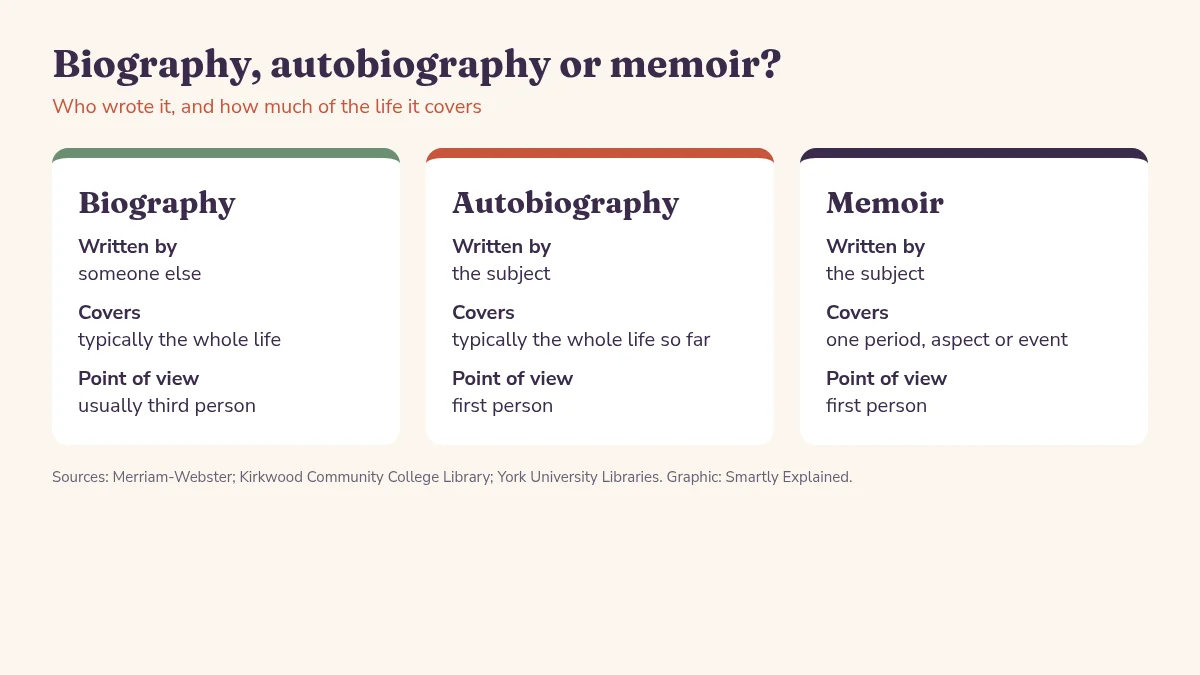
A biography is the story of a person's life written by someone else. An autobiography is the story of a person's life written by that person, usually covering their whole life so far. A memoir is also written by the person it is about, but it focuses on one part of their life: a period, a relationship, an event or a theme (Kirkwood Community College Library; York University Libraries).
In this explainer
The short version: biography is "their life, by someone else," autobiography is "my life," and memoir is "a part of my life."
Side by side
| Biography | Autobiography | Memoir | |
|---|---|---|---|
| Who writes it | Someone other than the subject | The subject | The subject |
| Point of view | Usually third person ("she") | First person ("I") | First person ("I") |
| How much of the life | Typically the whole life span | Typically the whole life up to now | One period, aspect or event |
| Expectation of accuracy | Expected to be factual | Generally expected to be factual | Sometimes alters details, timelines or events in the telling |
| As a research source | Secondary source | Primary source | Primary source (York lists memoirs with autobiographies) |
Sources: Kirkwood Community College Library, York University Libraries, Merriam-Webster.
What the dictionary says
Merriam-Webster's definitions show why people mix these up: the words overlap.
- Biography: "a usually written history of a person's life." Merriam-Webster adds that a biography can be about someone still living, in which case it is necessarily incomplete (Merriam-Webster).
- Autobiography: "the biography of a person narrated by that person" (Merriam-Webster).
- Memoir: "a narrative composed from personal experience." Merriam-Webster also lists "autobiography" (usually in the plural, as in "his memoirs") and "biography" (as in "his memoir of his longtime friend") as senses of the word (Merriam-Webster).
So "memoirs," plural, is often used for a full life story, especially by public figures. York University Libraries notes that memoirs are usually written by politicians and military leaders, in the older, plural sense (York). In the library-guide sense used above, a single "memoir" is the focused, personal kind.
A three-question test for any book
- Who wrote it? If the author is not the subject, it is a biography.
- How much of the life does it cover? If the subject wrote it and it runs from childhood to the present, it is an autobiography.
- What holds it together? If the subject wrote it and it is organized around one stretch of time, one relationship or one question, it is a memoir.
A book can blur the lines. A focused book written by its subject is still a memoir even if the cover says "autobiography," and a public figure's "memoirs" may be a full autobiography.
Why the accuracy expectations differ
Biographers and autobiographers are generally expected to stick to verifiable facts. The Kirkwood Community College Library notes that in a memoir, some details, timelines or events may be altered in the telling (Kirkwood). Memoirists write from memory and shape a story around one theme. That is a reason to treat a memoir as one person's account, not a complete record.
The same library guide adds a tip for finding these books: memoirs are sometimes cataloged under the subject headings for autobiography or biography, so searching with all three words, plus "personal narratives," finds more of them.
Which one should you read or write?
| If you want | Look for |
|---|---|
| A researched overview of someone's whole life | A biography |
| A person's own account of their whole life | An autobiography |
| An intimate story about one experience, told by the person who lived it | A memoir |
| Primary sources for a school paper | Autobiographies, memoirs, letters and diaries (York lists all as primary sources) |
If you are planning reading time for any of these, our guide on how long it takes to read a 300-page book has a table for 15, 30 and 60 minutes a day.
Questions readers ask
Is a memoir the same as an autobiography?
They overlap. Both are written by the person they are about. Library guides describe an autobiography as covering the author's whole life so far, while a memoir focuses on one period, aspect or event.
Can a memoir be about someone else?
Merriam-Webster lists a biography sense for memoir, as in a memoir of a longtime friend. In that use the writer draws on personal knowledge of the other person.
Is a memoir nonfiction?
Yes, it is shelved and sold as nonfiction. The Kirkwood Community College Library notes that memoirs sometimes alter details, timelines or events in the telling, while autobiographies and biographies are generally expected to be factual.
Is an autobiography a primary source?
York University Libraries classes autobiographies as primary sources and biographies as secondary sources.
Sources and fact-check
- Memoir (definition), Merriam-Webster
- Autobiography (definition), Merriam-Webster
- Biography (definition and usage note), Merriam-Webster
- Memoirs: Home (what is a memoir?), Kirkwood Community College Library
- Primary Sources: Autobiographies, Memoirs, Letters, York University Libraries
Rules change. Spot something out of date? Tell us.