Why Do Candles Tunnel? Causes, Fixes by Depth, and the First-Burn Rule
Candles tunnel when the first burn ends before the wax melts edge to edge, or when the wick is the wrong size. How long to burn by diameter, fixes for shallow and deep tunnels, and safety limits.

The short answer
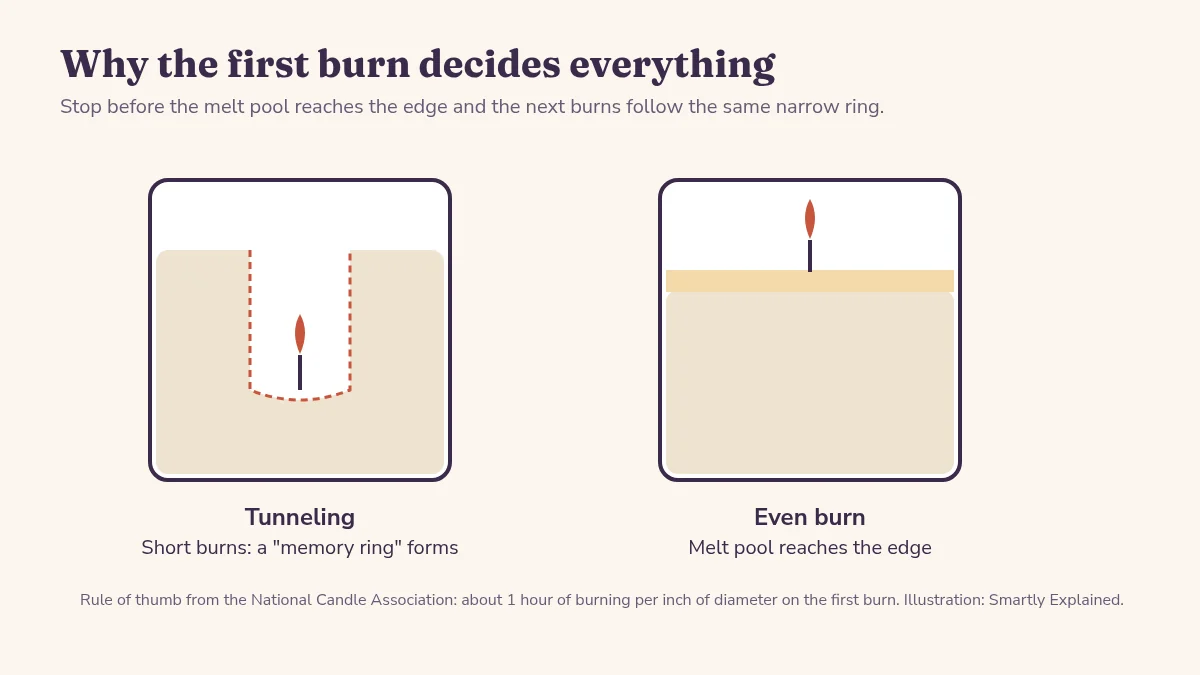
A candle tunnels when only the wax around the wick melts and a wall of solid wax stays around the edge. The usual cause is the first burn: if you blow it out before the melted pool reaches the sides of the jar, the wax forms a "memory ring" that later burns follow. A wick that is too small for the container, drafts, and cold rooms can cause it too. A shallow tunnel can be fixed; a deep one usually means it is time to rescue the wax or replace the candle.
In this explainer
The memory ring, explained
The National Candle Association (NCA), the U.S. trade group for candle makers, says that if a candle does not burn long enough for the wax to melt from edge to edge, it creates a memory ring, and once that happens it will keep tunneling for the life of the candle. Each later burn melts the same narrow channel, and the wall around it gets taller.
How long to burn a candle the first time
The NCA's rule is one hour of burning for every inch of diameter. Measure across the top of the wax, not the outside of a thick jar.
| Candle diameter | First burn (NCA rule) | Notes |
|---|---|---|
| 2 inches | About 2 hours | Small votives and tins |
| 3 inches | About 3 hours | Common jar size |
| 4 inches | About 4 hours | At the NCA's general 4-hour limit |
| Over 4 inches, single wick | Over 4 hours | Exceeds the general limit; check the label or choose a multi-wick candle |
The NCA also says candles generally should not burn longer than four hours and should cool for at least two hours before relighting. A wide single-wick candle that needs more than four hours to melt edge to edge is a design problem, not something to fix by burning longer.
Is it you or the candle?
| What you see | Likely cause | Source |
|---|---|---|
| Even pool on burn one, tunnel after a short burn later | A burn ended too early | NCA |
| Tunnel even after a full first burn, small flame | Wick too small for the container | CandleScience |
| Fast, deep narrow hole, large hot flame | Wick too large (less common) | CandleScience |
| Pool deeper on one side | Draft, or candle not level | NCA |
| Wick off center after cooling | Wick drifted in liquid wax | PartyLite |
PartyLite suggests nudging an off-center wick back to the middle before the wax cools. Moving air from fans, air conditioners or open windows also disturbs the flame, the NCA notes, so place the candle in still air.
Fixes, from shallow tunnel to deep
Shallow tunnel (less than about half an inch, wick easy to reach)
- Trim the wick to 1/4 inch and remove any debris from the wax, as the NCA advises before every burn.
- Light it and let it burn until the pool reaches the edge, staying within the label's maximum time.
Medium tunnel (wall of wax, wick still visible)
- With the candle unlit and cool, hold a hair dryer on low above the wax to soften the outer ring until the surface is level. Brands such as PartyLite suggest this.
- Let it set, trim the wick, then do a full edge-to-edge burn.
Deep tunnel (you can barely reach the wick)
- PartyLite describes wrapping aluminum foil around the top of the jar, leaving an opening of about 2.5 cm (1 inch), so heat reflects onto the outer wax for 1 to 3 hours. If you try this, stay in the room the whole time, keep the foil off the wick, and stop if the flame grows large or the glass gets very hot.
- Or scoop out wax around the wick, melt it in a warmer, and accept a shorter candle.
Replace it when: the wick is drowning, the flame keeps going out, or the glass is very hot or cracked. The NCA says to stop burning when 1/2 inch of wax remains.
Safety while you fix it
Fixes that keep a flame going longer raise the stakes. The NFPA reports that from 2014 to 2018, U.S. fire departments responded to an average of 7,610 home fires started by candles each year, and three of every five started when something that could burn was too close to the candle. The NCA's safety tips and the U.S. Fire Administration agree on the basics:
- Never leave a burning candle unattended, and blow it out when you leave the room or go to bed.
- Keep it at least 12 inches from curtains, bedding, books and anything else that burns.
- Use a stable, heat-resistant surface, away from children and pets.
- Do not move a candle while the wax is liquid.
Prevent it on the next candle
- Plan the first burn for an evening when you are home for the full hour-per-inch time.
- Trim the wick to 1/4 inch every time.
- Keep it out of drafts and on a level surface.
- For containers wider than about 4 inches, choose a candle with two or three wicks.
Questions readers ask
Can a tunneled candle fix itself?
No. The National Candle Association says once a candle has a memory ring it will continue to tunnel for the life of the candle unless you even out the wax.
How long should I burn a new candle the first time?
About one hour for every inch of diameter, per the National Candle Association, so a 3-inch candle needs about 3 hours. Stay within the manufacturer's maximum burn time, which the NCA says is generally four hours.
Is it safe to use a hair dryer on a tunneled candle?
Candle brands suggest a hair dryer on low over an unlit candle to soften the outer wax. Never use it on a lit candle, and keep the cord and dryer away from the flame area.
Do soy candles tunnel more?
Wax type is only one factor. CandleScience, a candle-making supplier, says tunneling in soy candles is usually a sign the wick is too small for the container, and occasionally too large.
Sources and fact-check
- Your Foolproof Guide to Burning a Candle Correctly, National Candle Association
- Candle Safety Tips, National Candle Association
- FAQs, National Candle Association
- Soy Wax Troubleshooting Guide, CandleScience
- What Is Candle Tunnelling?, PartyLite UK support
- Candle fires (2014-2018 averages), National Fire Protection Association
- Candle Fire Safety, U.S. Fire Administration
Rules change. Spot something out of date? Tell us.